
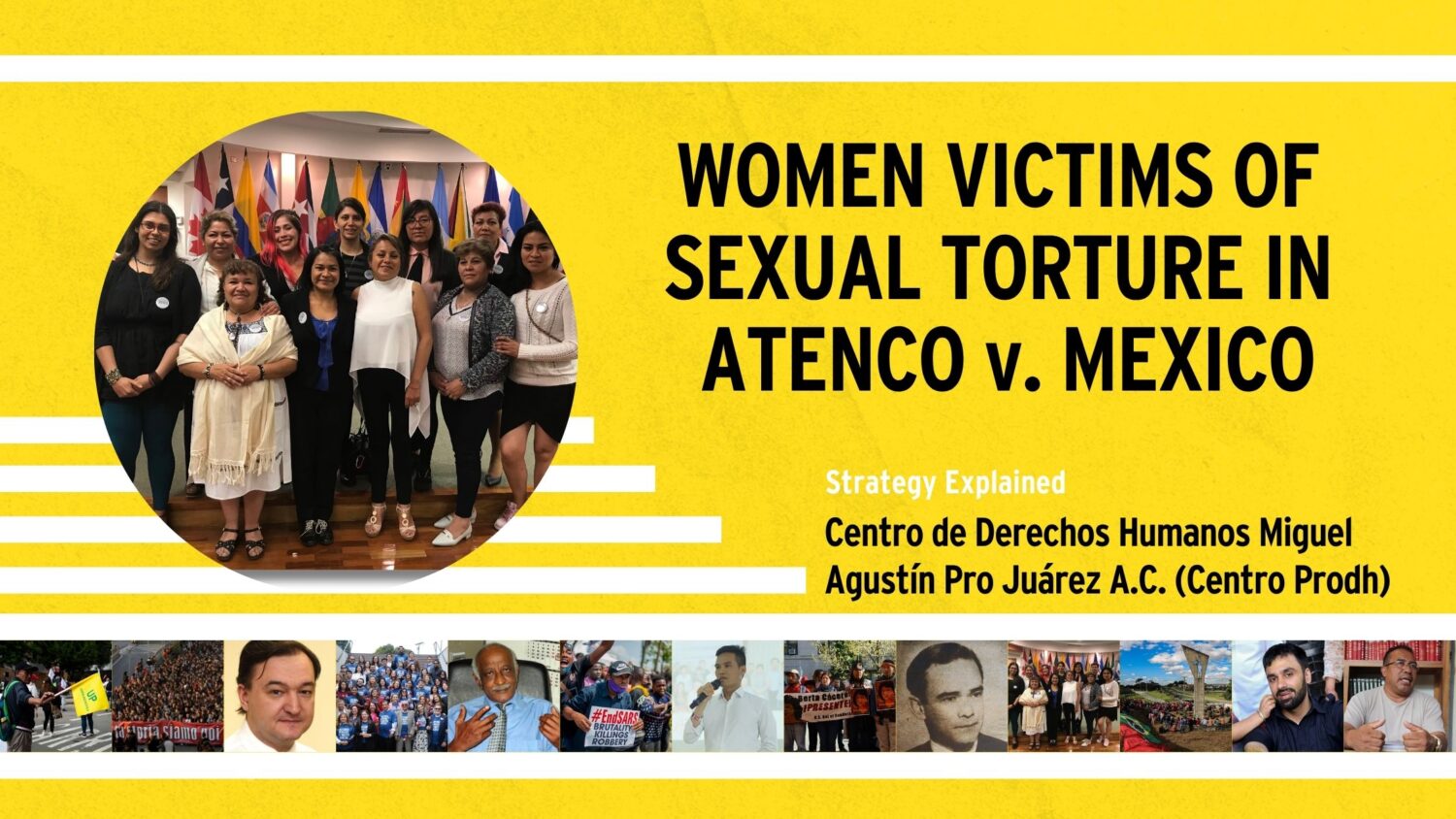
Women of Atenco: The Fight Against Sexual Torture in Mexico Continues After Two Decades of Impunity
By the Centro de Derechos Humanos Miguel Agustín Pro Juárez A.C. (Centro Prodh)
This is the second blog in a series featuring legal representatives and experts in strategic litigation against torture, reflecting on the impact of cases featured in Casebook 2.
In this blog, the Centro de Derechos Humanos Miguel Agustín Pro Juárez A.C. (Centro Prodh), a Mexican organisation advocating for marginalised communities and systemic justice reform, examines the strategic significance of the case Women Victims of Sexual Torture in Atenco v Mexico.
After being denied justice domestically, the women survivors brought their case before the Inter-American Court of Human Rights, which ruled in their favour in 2018. The Atenco case exposed the use of sexual torture by security forces as part of a broader pattern of gender-based violence in Mexico.
“We have insisted countless times that one of the objectives that drives us, and that has not allowed the passage of time and impunity to overwhelm us, is the idea that speaking out could stop the practice of sexual torture and that, in some way, our denunciation could translate into the guarantee that no woman would ever live through what we lived.”
These are the words of Norma Jiménez, one of the survivors of the repression that took place on 3 and 4 May 2006, in San Salvador Atenco and Texcoco, Mexico, which resulted in arbitrary detentions, torture, and sexual torture. She spoke during the latest compliance hearing monitoring the implementation of the judgment of the Inter-American Court of Human Rights (IACtHR). The ruling was issued in November 2018, after 11 women survivors of sexual torture who had not seen justice in Mexico turned to the Inter-American system, accompanied by the Centro Prodh and the Center for Justice and International Law (CEJIL).
Failure to implement the reparations measures
Unfortunately, 20 years after the events and nearly eight years after the IACtHR judgment, there remains a lack of compliance with the reparations ordered. This includes shortcomings in health and education measures, structural actions such as strengthening the Monitoring Mechanism for Sexual Torture Cases and creating an independent observatory on the use of force, as well as failure to properly investigate the events.
This is due to the lack of leadership from the Ministry of the Interior in coordinating authorities to implement these measures, the excessive bureaucratization of victim assistance under the Executive Commission for Victim Attention (CEAV), and entrenched pacts of impunity that have prevented a comprehensive investigation of the operation — including the chain of command — as ordered by the Court.
Regarding the investigation, there has been no progress in the inquiry led by the Special Prosecutor for Crimes of Violence against Women and Human Trafficking (FEVIMTRA). There is not a single conviction against the perpetrators. The chain of command of the operations — in which more than 2,000 municipal, state, and federal officers participated — has still not been investigated. There is still a lack of medical and psychological care, as well as the absence of institutional support to restore the victims’ life projects, and measures to prevent recurrence have not been implemented.
A symbol of determination and courage
The survivors themselves have filed legal actions in response to the fragmentation of investigations at the local and federal levels. Their right to participate and be informed about the investigations has not been guaranteed. Additionally, the authorities have acted deficiently by repeatedly submitting flawed arrest warrant requests, failing to address the factual framework established by the IACtHR and omitting the responsibility of high-ranking officials.
For this reason, prominent international lawyers have recently joined the women’s demands, submitting an amicus curiae to the IACtHR to denounce omissions in the investigation and to highlight the need for it to include the international standards arising from such a significant ruling as the Atenco case.
Twenty years after Atenco, impunity allows sexual torture to continue as a practice used against women detainees, as established by the National Diagnostic Report on Sexual Torture: nearly 8 out of every 10 detained women were subjected to some form of physical torture during detention, and 44% experienced some form of sexual violence.
Despite the bleak picture of 20 years of impunity, the voices of these women remain a powerful example of determination and courage. They have asserted that sexual torture is a practice with differentiated impacts on women, accompanied by stereotypes and reinforcing violence and discrimination against them.
This is the legacy of Paty Romero, Paty Torres, Suhelen, Italia, Norma, Edith, Mariana, Claudia, Yolanda, Ana María, and Cristina—11 women who broke the silence about sexual torture and have reported that these acts occur and said they must never happen again. Today, when it is declared from Mexico’s presidency that “it is the time for women,” we must recognise the bravery of these survivors who have raised their voices against sexual torture so that no one else suffers it again. And the State, beyond just words, owes them truth, justice, and reparation.
The REDRESS Casebook series was produced with financial assistance from the European Union under the United Against Torture Consortium initiative. Its contents are the sole responsibility of REDRESS and do not necessarily reflect the views of the EU.