
When Discrimination Becomes Torture: The Hidden Violence inside Mexican Prisons
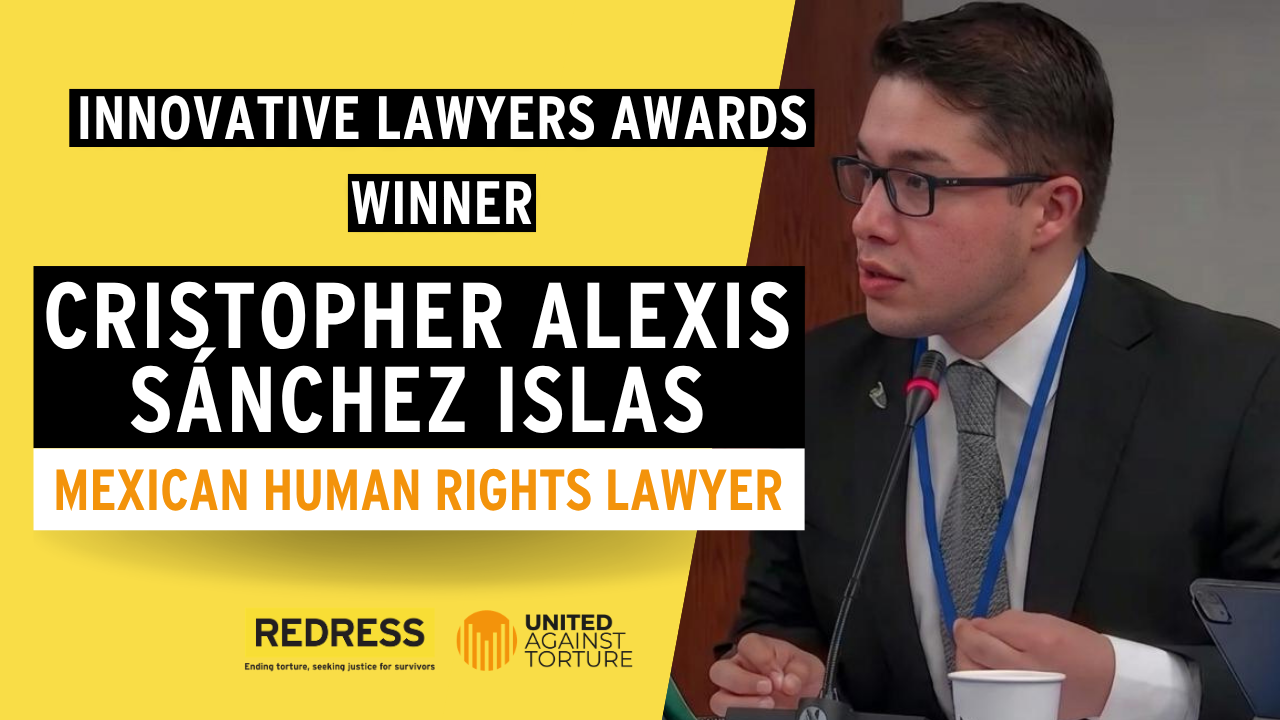
By Cristopher Alexis Sánchez Islas, Innovative Lawyers Awards Winner
Cristopher Alexis Sánchez Islas is a Mexican human rights lawyer and recipient of the REDRESS Innovative Lawyers Award. He serves as Coordinator of the Comprehensive Defense Area at Asistencia Legal por los Derechos Humanos A.C. (ASILEGAL), a civil society organisation dedicated to defending and promoting the rights of vulnerable individuals within the criminal justice and penal systems, particularly those deprived of liberty.
In this blog, Christopher Islas highlights that torture in prisons does not occur solely through direct physical violence but can also emerge from systematic discrimination and neglect. He highlights how everyday discriminatory practices—when sustained and severe—can evolve into forms of torture, as seen in the conditions within Mexican prisons.
When we think about torture, we usually picture physical violence, threats, insults, or methods designed to break a person’s will. These acts are often associated with coercing confessions or fabricating criminal charges. But what if torture does not only begin with physical violence, but also with discrimination and exclusion? This is the reality of torture based on discrimination: a silent and often invisible form of violence that disproportionately affects vulnerable groups, including people deprived of liberty.
A hidden form of torture
The Convention against Torture and Other Cruel, Inhuman or Degrading Treatment or Punishment establishes that severe physical or mental pain intentionally inflicted for purposes such as obtaining information, intimidation, coercion, or “for any reason based on discrimination of any kind” may constitute torture when committed by public officials or with their acquiescence. Discrimination, meanwhile, involves distinctions, exclusions, or restrictions that impair the equal exercise of human rights. When those exclusions and abuses generate severe suffering, discrimination can meet the threshold of torture or ill-treatment.
However, not every restriction of rights amounts to torture. Isolated acts may constitute abuse or discrimination without reaching that threshold. But when degrading practices become prolonged, systematic, and cumulative, they can create what the United Nations has described as “torturous environments”.
This is particularly evident in prisons. People deprived of liberty depend almost entirely on prison authorities for access to food, healthcare, communication, safety, and dignified living conditions. In such contexts of absolute dependence, discriminatory practices such as humiliation, denial of services, arbitrary punishment, or prolonged isolation can cause profound physical and psychological suffering. At that point, discrimination is not only a violation of equality but also becomes a form of torture or ill-treatment.
Torturous environments in Mexican prisons
In Mexico, this is no longer a theoretical discussion. According to the National Survey of the Population Deprived of Liberty (ENPOL), by 2021 at least 37,356 people deprived of liberty had experienced discriminatory acts in prison. The most common included humiliation (85.2%), physical aggression such as pushing, kicking, or hitting (18.7%), verbal threats (12.4%), restrictions on goods and basic services (8.7%), punishments (5.5%), and blows with objects (5.0%).
The survey also documented disciplinary measures that may amount to torture or ill-treatment, including isolation exceeding the 15-day limit established by national and international human rights standards (27,972 cases), physical punishment (14,119), deprivation or reduction of food and drinking water (11,532), and sleep deprivation (10,454). The states with the highest number of reported discriminatory acts were the State of Mexico (8,326), Mexico City (6,233), Puebla (1,779), Baja California (1,711), and Sonora (1,397).
The continuity and accumulation of these conditions risk turning prisons into torturous environments. One of the clearest examples is CEFERESO 16, a federal women’s prison in Coatlán del Río, Morelos.
The case of CEFERESO 16
CEFERESO 16 has been marked by structural conditions that threaten the lives and integrity of women deprived of liberty. These include the absence of a gender-sensitive approach to detention, limited access to social reintegration measures and economic, social, and cultural rights, disproportionate restrictions on contact with the outside world, and persistent violence within the prison. Together, these factors create conditions conducive to suicide and severe psychological suffering.
In 2022, the National Human Rights Commission (CNDH) issued Recommendation 54/2022 regarding the death in custody of a woman detained at CEFERESO 16. In 2020, “V” — a woman living with a psychosocial disability and in a situation of socioeconomic vulnerability — died by suicide following a chain of institutional omissions, including failures to implement suicide prevention protocols, deficient medical care, and obstacles preventing communication with her family.
The CNDH considered that those conditions amounted to torture based on discrimination, as the penitentiary system caused her severe and prolonged suffering by excluding her from dignified care due to her status as a woman, her poverty, her disability, and her deprivation of liberty. In this case, discrimination became the basis for institutional inaction, transforming negligence into ill-treatment that stripped her not only of her rights and dignity, but ultimately of her life.
Although the ombudsperson ordered measures of reparation and guarantees of non-repetition, the structural conditions within CEFERESO 16 persist. Between 2022 and 2026, at least 21 women deprived of liberty reportedly died in this prison. Some public policies addressing mental health have since been implemented, but they remain insufficient, as discriminatory practices and harmful prison conditions persist.
An invisible crisis
Torture based on discrimination remains largely invisible across many countries and institutions. There is still insufficient data to identify, measure, and confront these practices, particularly in highly restrictive settings such as prisons.
Recognising torturous environments is essential to preventing this violence from becoming normalised. Governments must strengthen oversight, accountability, and prison policies capable of addressing the structural discrimination that enables severe suffering to persist behind prison walls. Otherwise, people deprived of liberty will continue to face conditions incompatible with dignity, equality, and human rights.
About the Innovative Lawyers Awards
REDRESS’s Innovative Lawyers Awards recognise the vital work of new and emerging anti-torture champions, expose them to a broader peer support network, provide financial support to pursue public interest litigation and to inspire other lawyers and practitioners. This support is made available through the United Against Torture Consortium, which is funded by the European Union. The contents of the Innovative Lawyers Awards blog series are the sole responsibility of the authors and do not necessarily reflect the views of the European Union or REDRESS.