
“We need to be heard” Survivor voices at the heart of reparation for Ukraine
By Ana Cutts Dougherty, Consultant Lawyer
At a critical moment for the design of reparation for Ukraine, survivor voices helped shape the conversation in The Hague (Netherlands) around what an effective, accessible, and credible international compensation process must deliver in practice.
The discussion brought survivor-activists into direct dialogue with key institutional actors, including Ukrainian Ambassador Andriy Kostin and Markiyan Kliuchkovskyi, Executive Director of the Register of Damage for Ukraine. Their engagement created an opportunity to connect survivors’ priorities with the political and institutional decisions that will determine whether reparation reaches those most affected.
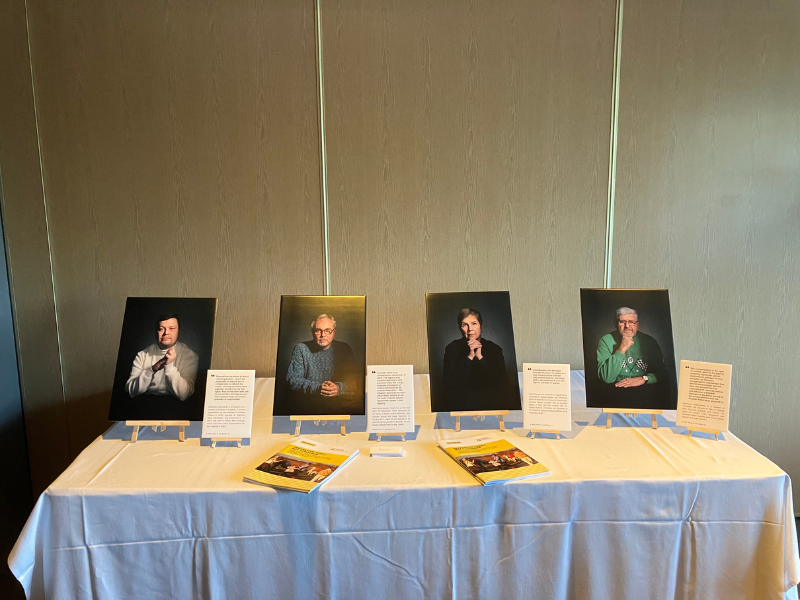
The accompanying photo exhibition amplified this impact by giving space to Ukrainian survivors from seven different survivor-led organisations to set out, in their own words, what reparation means to them. Through portraits (by photographer De Sheng Lim) and personal testimonies, survivors identified key issues that should shape the international compensation mechanism—including its temporal scope and the need to ensure fair compensation through an inclusive process that reflects their lived experiences rather than institutional assumptions
“Survivors need to be heard”
Anhelina Dotsenko, an activist and survivor working with Numo, Sisters!, spoke candidly about the gap between existing processes and survivors’ realities. Many survivors, she noted, do not know where to seek help, and too often feel that their voices are not being heard.
She also stressed that harm does not fit neatly within legal timelines: her own experiences began in 2014, long before the full-scale invasion, and continued thereafter.
For Anhelina, a survivor-centred approach is the most important principle that should guide the international compensation mechanism.
“Survivor-centred means survivors participate”
Pavlo Shmulevych echoed this message. He is a Ukrainian economist, researcher, civil society advocate, and survivor representing ALUMNI, a network of Ukrainian men who survived captivity and torture. Drawing on his own experience, he highlighted that participation takes time: survivors may need space to heal before they are ready to engage.
Yet, the principle remains clear—no system can be described as survivor-centred if survivors themselves do not participate in the process of designing it.
He also emphasised the urgency of support. Survivors of torture and conflict-related sexual violence (CRSV) require access to medical and psychological care now, even as compensation mechanisms are still being developed.
Pavlo also stressed that not all harms can be approached in the same way. As he explained, the destruction of property cannot be equated with experiences of torture or conflict-related sexual violence, and these harms must be treated differently in the design of compensation mechanisms. This includes recognising and accounting for the specific costs of recovery for survivors of torture and CRSV, such as long-term medical and psychological support. Reparation frameworks, he underscored, must reflect these differences if they are to respond adequately to survivors’ needs.
From principles to practice
The discussion shifted the debate from vague notions of survivor-centredness to practical requirements: clear communication, trust building, and pathways for survivors to navigate complex processes, as well as the need to manage expectations while ensuring that urgent needs are not neglected. These points are essential to whether the compensation mechanism can be used by survivors in practice, not only endorsed in principle.
A central message was that timing matters. While the international compensation mechanism will take time to develop, survivors’ needs are both immediate and evolving, and recovery depends on access to medical, psychological, and other forms of support.
Igor Cvetkovski, the Head of the International Organization for Migration’s Land, Property, Reparations and Transitional Justice Unit in Geneva, acknowledged the unique character of the international compensation mechanism, its inherent statutory and legal limitations, and emphasised that “continuous co-creation” must guide the mechanism. He also reflected on the need for complementarity, compatibility, and interoperability between this mechanism and the existing and prospective national mechanisms.
Fedir Dunebabin, Country Representative in Ukraine for the Global Survivors Fund, gave a simple roadmap for what continuous co-creation looks like: “ask, listen, improve, repeat”.
The take-away was clear: the credibility of the future international compensation mechanism will depend on whether it will be experienced by survivors as accessible, credible, and responsive to their realities. Anhelina and Pavlo offered a clear starting point: they called on those working to build the international compensation mechanism to listen early, continuously, and to let survivors’ priorities shape the mechanism.
The timing gave these messages particular significance. This event took place the same day as the first meeting of the Preparatory Committee for the International Claims Commission for Ukraine. The Committee is mandated to develop proposals and practical arrangements for the Claims Commission, including its rules of procedure and initial budget. By inviting members of the Preparatory Committee to hear directly from survivors and civil society, the discussion helped ensure that lived experiences could inform the earliest stage of the design.
This call is also reflected in a joint Open Letter signed by over 30 different Ukrainian survivor groups and Ukrainian and international CSOs, which urges early and meaningful engagement with survivors and civil society and makes specific requests to decision makers so that the future Claims Commission is effective, inclusive, and fit for purpose.