
Forced Virginity Testing Recognised as Torture: Landmark African Commission Ruling Against Egypt
By Alejandra Vicente, REDRESS Head of Law
This is the third blog in a series featuring legal representatives and experts in strategic litigation against torture, reflecting on the impact of cases featured in Casebook 2.
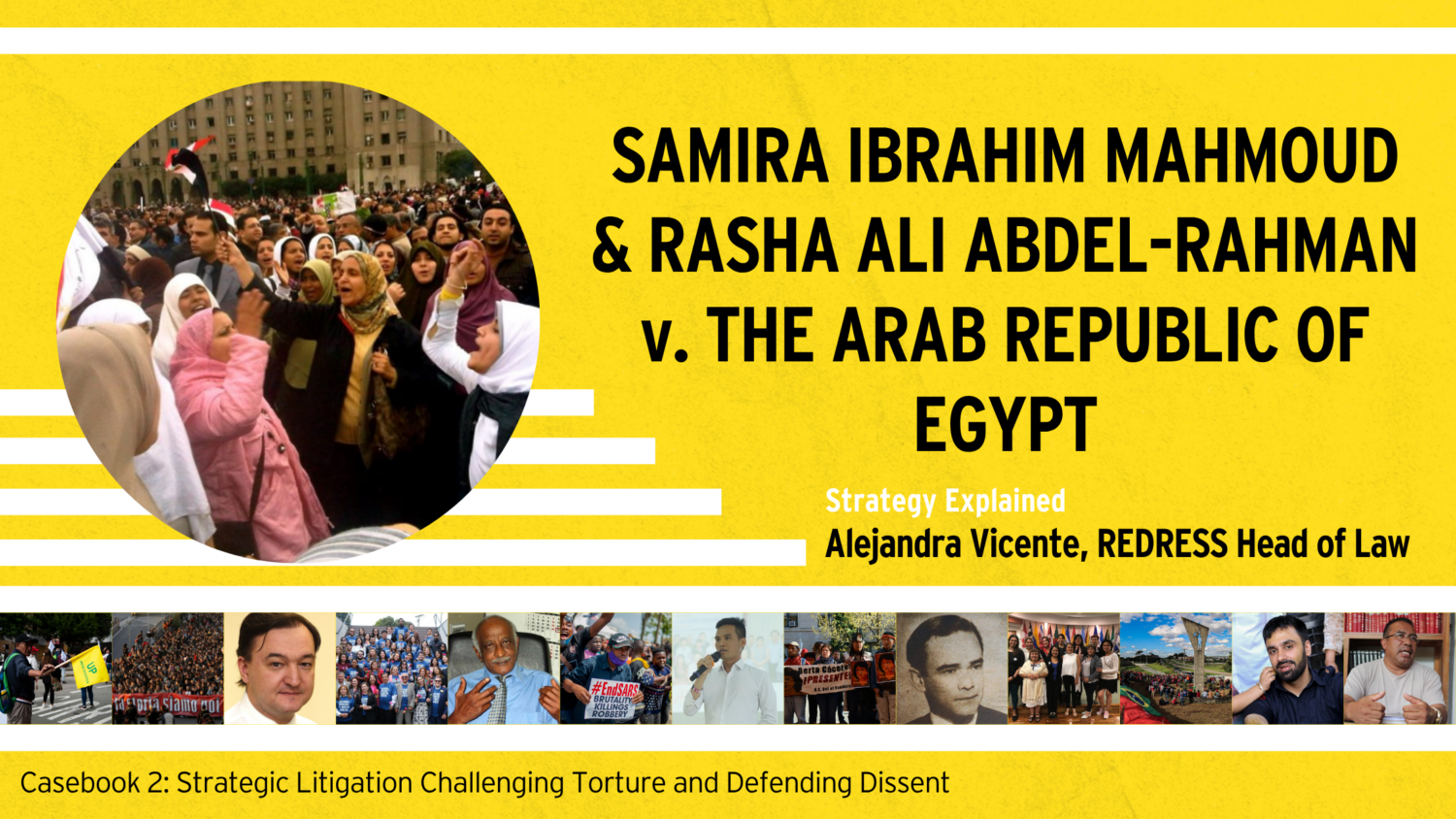
In this blog, Alejandra Vicente, REDRESS Head of Law, examines the African Commission on Human and Peoples’ Rights’ decision in Samira Ibrahim Mahmoud and Rasha Ali Abdel-Rahman v. Egypt, the first ruling by a regional or international human rights body to recognise forced “virginity testing” as rape and torture. The blog explores the abuse suffered by two women protesters during Egypt’s 2011 uprising, the Commission’s findings on torture, sexual violence and gender discrimination, and the significance of the decision for accountability and efforts to combat gender-based violence.
A Landmark Decision
In a landmark decision for the protection of women’s rights and prohibition of torture, the African Commission on Human and Peoples’ Rights (ACHPR) recognised that forced “virginity testing” is a form of rape and torture under international human rights law.
The decision in Samira Ibrahim Mahmoud and Rasha Ali Abdel-Rahman v. Egypt, adopted in May 2023 and made public in November 2025, is the first by a human rights body to address the legality of this abusive practice. It also marks an important step in recognising the relationship between gender-based violence and the suppression of political participation.
The Story Behind the Case
The case arose from events during Egypt’s 2011 popular uprising. On 9 March 2011, Samira Ibrahim Mahmoud and Rasha Ali Abdel-Rahman joined a peaceful demonstration in Cairo’s Tahrir Square, calling for democratic reforms and protesting the military’s violent response to earlier demonstrations.
The two women were arrested by military personnel, verbally abused, and subjected to severe mistreatment. While in military detention, they were forcibly stripped, humiliated in front of male officers, photographed without consent, and subjected to invasive genital examinations—commonly referred to as “virginity tests”. One woman was beaten and electrocuted, while the other was threatened with rape.
Following their detention, both women were convicted by a military court after proceedings that lacked basic fair trial guarantees. When domestic attempts to hold those responsible accountable failed, they turned to the African Commission on Human and Peoples’ Rights.
Forced virginity testing as a form of torture
The Commission found that Egypt had violated numerous rights protected under the African Charter on Human and Peoples’ Rights.
Most significantly, it concluded that forced genital examinations carried out by public officials in detention constituted rape and amounted to torture.
Relying on a joint statement by the Office of the High Commissioner for Human Rights, UN Women and the World Health Organisation, as well as an expert report provided by the International Council for Rehabilitation of Torture Victims, the Commission affirmed that there is no medical or legal justification for so-called “virginity testing”. It described the practice as illegal, inhuman, degrading, and inherently discriminatory. The Commission noted that virginity testing “reinforces stereotypes and gender inequality”.
The Commission also recognised that these abuses were not isolated acts of violence but were deliberately used to intimidate women participating in political protest.
Sexual Violence as a Tool to Silence Dissent
A key contribution of the judgment is its recognition that sexual violence was used to suppress democratic participation.
The Commission found that the abuse suffered by Samira and Rasha was intended to punish and discourage women from exercising their rights to freedom of expression and peaceful assembly. Sexual violence, verbal humiliation, and threats of rape were used not only against the victims themselves but also to send a broader message that women who participate in public protests would face gender-specific abuse.
This acknowledgement highlights how sexual violence can function not only as an individual human rights violation but also as a broader strategy for silencing dissent.
Challenging Gender Discrimination
The Commission also devoted significant attention to the discriminatory nature of the violations. Military officials repeatedly used misogynistic insults, accusing the women of being “prostitutes” and questioning their morality simply because they had participated in public demonstrations. The Commission said these actions reflected discriminatory attitudes aimed at punishing women who challenge traditional social expectations.
Importantly, the decision criticised not only the conduct of military officials but also the attitudes displayed during subsequent investigations, where victims were questioned about their marital status, clothing, and employment rather than the abuses they had suffered. The Commission considered these responses further evidence of institutional discrimination against women protesters.
The Commission further observed that the physical violence inflicted on the victims was “gender specific”, as they were subjected to acts of sexual harassment and physical violence that could only be directed at women, including virginity testing, breasts fondling, and other forms of sexual abuse.
A Strong Message on Accountability
Beyond recognising the violations, the Commission ordered Egypt to investigate and prosecute those responsible and provide financial compensation to the victims.
It also recommended broader institutional reforms to prevent similar abuses, including stronger safeguards during detention, ensuring respect for detainees’ bodily integrity during searches and medical examinations, and limiting the role of military courts in investigating abuses committed by military personnel.
Why This Decision Matters
This judgment represents a major milestone in international human rights law. It is the first decision by the African Commission—or any other regional or international body—to comprehensively analyse forced virginity testing under regional human rights law.
Beyond establishing an important legal precedent, the decision strengthens legal recognition that gender-based violence is often used to silence political dissent and deter women from participating in public life. It is therefore likely to influence future litigation, advocacy, and law reform both across Africa and beyond.
Looking Ahead
The case of Samira Ibrahim Mahmoud and Rasha Ali Abdel-Rahman v. Egypt stands as a powerful reminder that human rights violations committed during a period of political unrest must not be beyond the reach of justice.
By recognising forced virginity testing as rape and torture, and affirming women’s rights to participate in public life free from violence and intimidation, the African Commission has set an important precedent for survivors, lawyers, and human rights defenders worldwide. Beyond delivering justice for Samira and Rasha, the decision strengthens international efforts to end gender-based violence, combat impunity, and ensure that States areheld accountable for violations committed.
The REDRESS Casebook series was produced with financial assistance from the European Union under the United Against Torture Consortium initiative. Its contents are the sole responsibility of REDRESS and do not necessarily reflect the views of the EU.
Other blogs in this Casebook series: