
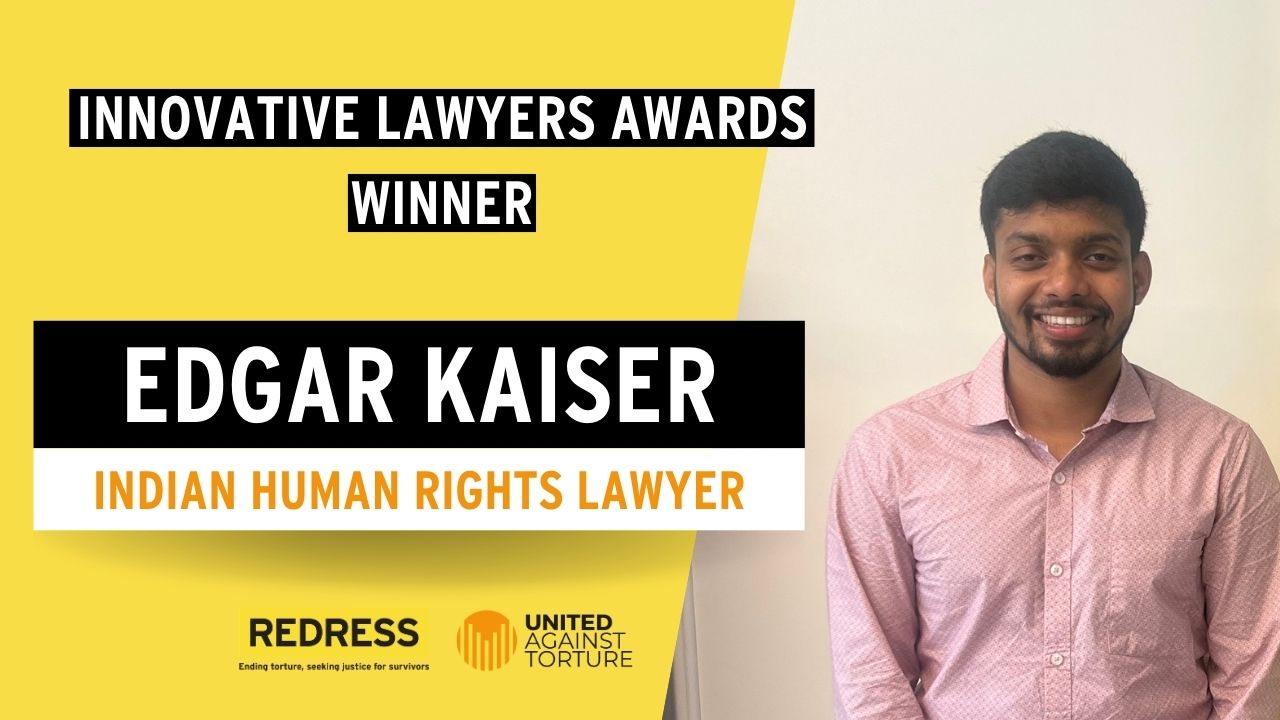
Interview with Edgar Kaiser: Indian Human Rights Lawyer and Innovative Lawyers Awards Winner
Edgar Kaiser is a human rights lawyer from India and a recipient of REDRESS Innovative Lawyers Award. He works with People’s Watch, an organisation dedicated to combating injustice and discrimination across India.
Edgar spoke to us about the challenges faced by human rights defenders, and the deep structural inequalities that lead to torture and human rights abuses against marginalised communities. Despite these risks, he remains driven by the inspiration he draws from his work with victims and from witnessing the real impact his work has on people’s lives.
What is it like to be a human rights defender in India?
To be a human rights defender in India is a very critical thing. Our bank accounts are being frozen, false charges are being slapped against us, and our liberty is being compromised. In extreme cases, our lives are taken.
Since 2011, around 20,000 individuals have lost their FCRA license, meaning their bank accounts have been frozen, our own office is among them. Many thousands of human rights defenders are put behind bars without any legitimate trial, subjected to illegal detention. Thousands of journalists are facing the weaponisation of the law.
Sadly, several human rights defenders lost their lives due to State oppression and reprisal. So, the situation and the political climate are very, very risky and really not good for any human rights defender. However, we are very hopeful. As Mr. Henri says, human rights work is always a collective work, and not an individual work. This support and solidarity from fellow human rights defenders and civil society organisations remind us of the fact that we are not alone in this battle, and this is the hope that keeps us going in this very risky work.
Who are the principal perpetrators of torture in India?
The principal perpetrators of torture in India are the police personnel, who are right from the higher level to the lower level. There are also forest officials who have been involved in extrajudicial killings. There have been many cases in which they have shot down agricultural labourers and poor tribal [people] who simply ventured into the forest for simple reasons.
There are the other set of perpetrators who belong to the armed forces, who are empowered by the Armed Forces Special Powers Act of 1958 (AFSPA), who have unfettered powers to inflict all kinds of torture on people, and the conflict in Manipur is a great example of this.
Several other national-level investigative and law enforcement agencies have also been involved in the brutal torture of the common man, and in particular, people who take up this human rights work.
In what contexts does torture often occur in India?
The context in which the torture occurs has multifaceted reasons. One is the non-ratification of UN Convention Against Torture (UNCAT), and the absence of a municipal law. But the primary reason is more historical, political and social. In 1870, when the British ruled us, the Criminal Tribes Act labelled certain tribal communities in India as ‘born criminals’, who are still being subjected to torture.
Similarly, there’s the 1861 Police Act that the British police used to inflict brutal forms of torture on people. There is evidence in the historical context that torture has become deeply entrenched in the system of police officials and the authority, the bureaucracy in general. Even today, people who belong to the economically underprivileged and socially underprivileged classes are being dragged into police stations just like that and being subjects of torture in day-to-day policing.
What have you done to support the anti-torture movement?
There is this summer camp initiative that they’ve been doing for more than 20 years now, a summer camp exclusively meant for children belonging to victim families of police abuse. These children, who are traumatised for life, who are unrecognised anywhere in the criminal justice process, are being taken and brought together in these summer camps that we conduct annually. We provide psychosocial and psychological support, along with cultural sports, and relaxing activities that bring them back to their childhood. Then they are put together with the many children who have come across the same kind of experience in their lives, so they feel that they are not alone.
What motivates you to continue your work?
I am encouraged and motivated by the fact that there are victims out there in the street whose voices go unheard by the government. Those people, when they come to us, and they say that if not for your work, we would not have ever imagined ourselves being or marching forward in this path to justice. When they give us such testimonies, it is those words that keep us going.
More than being proud, it is always the feeling of gratitude that I have always gotten in this field since the past year I’ve been involved in this full time.
One particular moment was when I joined a protest site with villagers of a particular locality who had been protesting against the Government for their forced eviction. I had to be there at the protest site at around 12 am in the night. And the next morning, when the victims whom I joined in the protests came to our office, they told Mr Henri, our Director, that [my] presence and [my] voice of support had strengthened them.
There have been many other instances where victims with whom I am consistently in contact tell me that they will miss me in the office, or maybe they will feel that void in the office when I left. Those words of support and, you know, a sense of connection are something that I really hold very close to my heart.
About the Awards
REDRESS’s Innovative Lawyers Awards aim to recognise the vital work of new and emerging anti-torture champions, expose them to a broader peer support network, provide financial support to pursue public interest litigation and to inspire other lawyers and practitioners. This support is made available through the United Against Torture Consortium, which is funded by the European Union.