
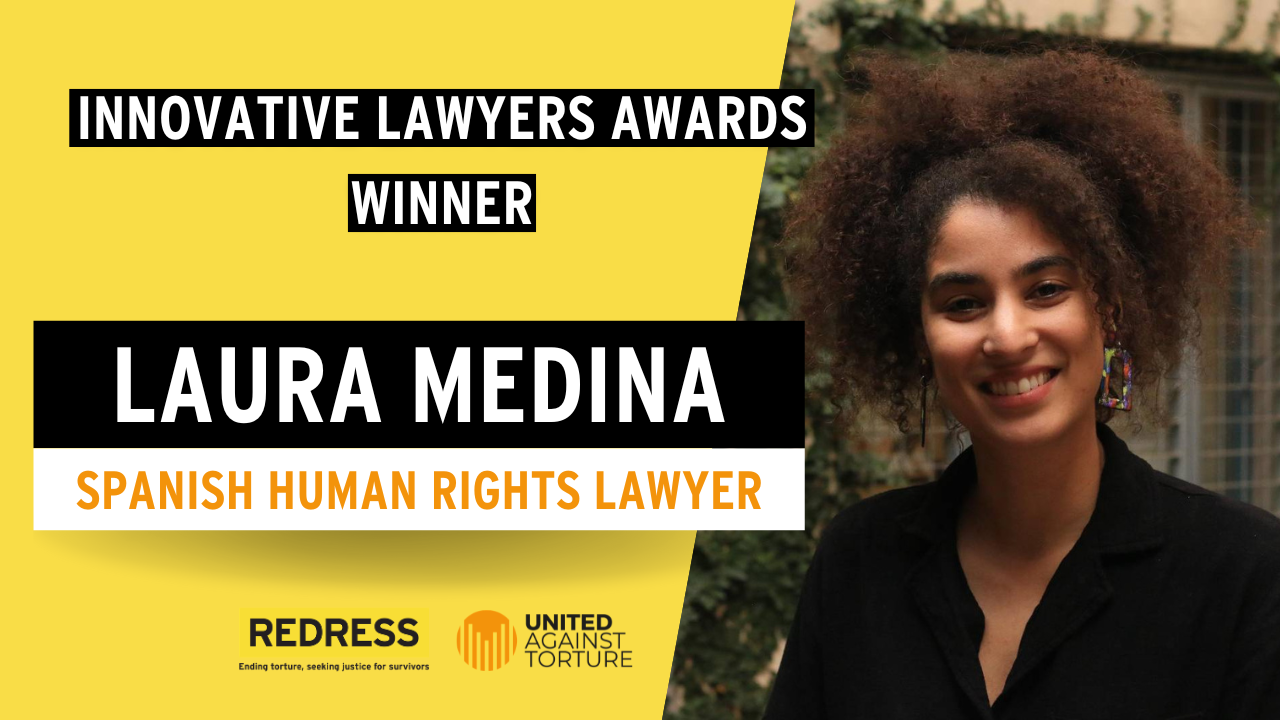
Interview with Laura Medina: Spanish Human Rights Lawyer and Innovative Lawyers Awards Winner
Laura Medina is a human rights lawyer in Spain and a recipient of the REDRESS Innovative Lawyers Award. She spoke about the realities of documenting and litigating torture in a system marked by institutional resistance.
Working with Irídia – Centre for the Defence of Human Rights, Laura handles cases of ill-treatment in detention, during protests, in public spaces, and at Spain’s southern border, which are often rooted in ethnic and racial profiling and structural racism. She explained how state security forces, prison officers, and private security actors are key perpetrators.
What does it mean to be a human-rights defence lawyer in Spain? What kinds of pressures have you faced in your work?
Being a human-rights lawyer in Spain, specifically working on reporting torture and ill-treatment—means facing many difficulties and institutional resistance.
For example, regarding victims’ right of access to justice, we as lawyers who file complaints often find ourselves carrying the burden of pushing judicial investigations forward almost single-handedly. We cannot ignore that Spain has a serious problem when it comes to investigating torture and ill-treatment allegations.
The European Court of Human Rights and Spain’s Constitutional Court have condemned the Spanish State several times for failing to investigate torture sufficiently and effectively. Because of this, you sometimes feel alone. The work takes a heavy toll, both in terms of resources and emotional well-being.
That is why working in networks with different human rights organisations is so important. Collaborating with organisations like Irídia help makes the work more sustainable, especially when it comes to securing independent funding. For example, I collaborate through a service that provides free legal and social support for cases of institutional violence, and sustaining this work is not always easy.
Who are the main perpetrators of torture in Spain, and in what contexts does it occur?
The main perpetrators of acts of torture and ill-treatment in Spain are state security forces, including various police bodies. We also see cases involving prison officers and private security agents who carry out public security functions. These actors are responsible for abuses in several key contexts.
First, in situations involving deprivation of liberty, including prisons and immigration detention centres.
Second, in public spaces, particularly in connection with ethnic and racial profiling. Many organisations working on these issues denounce this as an example of structural racism within Spanish State.
Third, in protest settings, particularly where people are exercising their rights to assembly and demonstration.
Finally, there is a specific context of Spain’s southern border, where we observe systematic human rights violations. I would also add a related concern on the shrinking of civil society space. We are documenting cases of police infiltrations, as well as aggression and legal actions brought against journalists.
Can you describe an initiative that you have worked on that contributed to advancing the global movement against torture?
As I mentioned, I’m part of an organisation called Irídia – Centre for the Defense of Human Rights, based in Barcelona. One of the tools I’ve been able to work with is strategic litigation.
This year, for example, I contributed to litigation in a serious case of police abuse committed by the regional police officers in a public space against a young man. The incident was recorded, and a conviction was secured for unlawful detention, falsification of documents, bodily harm, and offences against moral integrity, which is one of the ways in which allegations of torture and ill-treatment are legally framed in Spain.
This ruling is particularly important because such serious crimes are difficult to prove. The case could serve as a useful precedent for similar situations.
I would also highlight the first criminal complaint for Franco-era torture that I helped file, after the new Democratic Memory Law came into force in October 2022.
Another significant ongoing case concerns the assault of an asylum seeker at the Melilla border fence, exemplifying the systematic human rights violations taking place at Spain’s southern border.
What should be the next steps to eradicate torture in Spain?
Truth, justice, reparation, and guarantees of non-repetition are a long road. It is a long-term process. Although progress has been made, much work remains to be done in the Spain.
This work must necessarily be interdisciplinary. Effective strategies require cooperation and collaboration with civil society organisations, bringing together professionals from different fields.
I think it is essential to develop strategies that ensure public institutions acknowledge and accept responsibility for such serious violations.
What motivates you to keep going?
I believe that what motivates me most to continue working and supporting affected people is seeing that the practice of law can have a real purpose. Legal proceedings are complex, very long, and often extremely painful. Reporting institutional violence is not easy.
However, seeing that this work can help influence a judicial ruling or shape public policies that may benefit others, and can contribute in some way to upholding the absolute prohibition of torture, I think, is significant, important, and meaningful.
About the Awards
REDRESS’s Innovative Lawyers Awards aim to recognise the vital work of new and emerging anti-torture champions, expose them to a broader peer support network, provide financial support to pursue public interest litigation and to inspire other lawyers and practitioners. This support is made available through the United Against Torture Consortium, which is funded by the European Union.