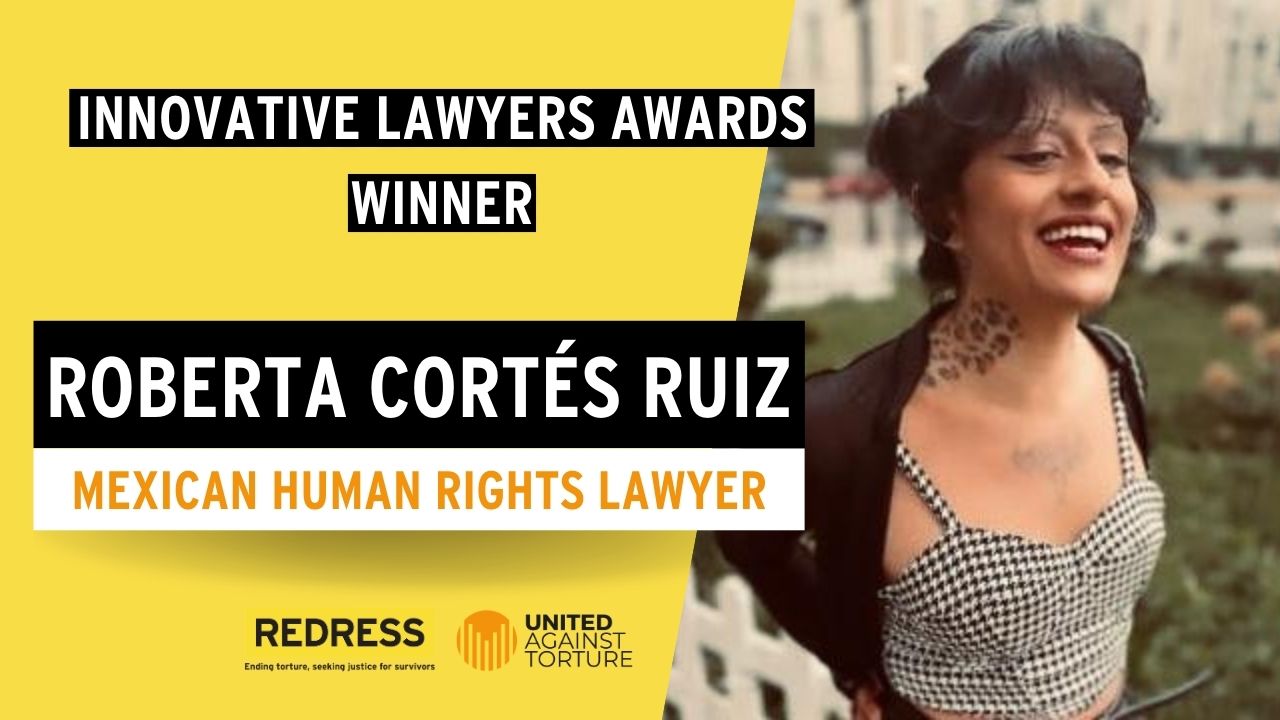
Interview with Roberta Cortés Ruiz: Mexican Human Rights Lawyer and Innovative Lawyers Awards Winner
Roberta Cortés Ruiz is a human rights lawyer from Mexico and a recipient of the REDRESS Innovative Lawyers Award. She works as a consultant and accompanies survivors of torture and other human rights violations in their pursuit of justice.
Roberta has collaborated with Almas Cautivas, an organisation that works closely with people deprived of liberty and promotes actions that support the successful reintegration of those who have regained their freedom. Through this work, she has supported many LGBTIQ+ individuals, particularly trans women. She believes that the future of anti-torture work must be collective and interdisciplinary, and that survivors and their families should be recognised as human rights defenders in their own right.
What does it mean to be a human rights lawyer and defender in Mexico, and what pressures have you faced in this work?
I think it is a risk in Mexico to be a human rights defender. From a general perspective, it is a risk in Mexico because of the political context we are living in, as well as the very widespread context of violence that surrounds us.
Also, because of how power is exercised in Mexico. Power is exercised not only by political power, from public officials, but also through organised crime. This creates a constant danger because you never know who you are up against. There are so many networks of power in Mexico. We may not know whether a prosecutor has ties to someone in organised crime, or whether that prosecutor has ties to the police, or to the public official responsible for torturing someone.
On the other hand, just for being a trans person, you are inherently at risk in Mexico. In particular, being a trans woman is a complicated issue. In fact, Mexico is the second country in Latin America with the highest number of murders of trans women.
Who are the main perpetrators of torture in Mexico?
First, it is important to recall that in 2014, the former Special Rapporteur on torture stated that torture in Mexico is widespread. When we say torture is widespread, it means that anywhere a person may be deprived of their liberty, they can be a victim of torture.
There are certain contexts where we have more information showing that torture happens, but that does not necessarily mean that those are the only places where it occurs.
For example, although it is not officially recognised, and has even become normalised, one place where cruel and degrading treatment can occur is within public hospitals. Many public hospitals are extremely overstretched. If you have an illness, you may be given an appointment a year later, and you just have to hope you survive until then. That’s one aspect.
Can you describe an initiative you have worked on that contributes to advancing the global movement against torture?
Currently, part of my work involves litigating cases of people who have been victims of torture, both in the prison context and during detention. Another part of my work involves accompaniment. By that I mean offering legal advice, either at low cost or free of charge, to people who have been victims of torture or who are simply in a situation of detention.
Together with another organisation, we created a group called the Fire and Freedom Brigade, which supports survivors of torture, as well as people with specific healthcare needs. I also work with an organisation called Almas Cautivas, which works with LGBTIQ+ people who are deprived of their liberty, particularly trans women, who are the group we work with most closely.
In terms of very specific initiatives, I also contributed to the drafting of the National Law on the Execution of Criminal Sentences, which establishes the legal framework for how justice is administered in prisons. I was very actively involved, as part of a civil society group that was involved in developing that law.
How do you see anti-torture work evolving in Mexico?
I believe anti-torture work must evolve collectively and in an interdisciplinary way. I also think we need to stop focusing so much on the role of lawyers and begin incorporating other disciplines that could support the fight against torture. At the same time, we must recognise the role of survivors or family members of survivors of torture. I think they, too, have much more to say than sometimes lawyers do, and I think they should also be recognised as human rights defenders.
What has been your proudest moment in this field so far?
Three things make me particularly proud. First, the way I accompany people in their legal process. I try to approach this work differently from the traditional role of a lawyer. For me, accompaniment is not driven by economic interest. There are other ways of giving and receiving support, and the way I work with people is something I value deeply.
Second, would be how I have built networks. Not necessarily with other lawyers, but with people who have survived very serious human rights violations committed by the State. Building those relationships has been meaningful because it represents another way of practising law.
Third, as a trans woman, it is a source of pride for me to show up in courtrooms, even though I know people look at me badly. Sometimes, court officials do not even want to accept my written submission because they are not used to seeing trans women working as lawyers. Some have even tried to remove me from courthouses with police. They refuse to accept my filing, just like that.
But I have the strength to remain there and say, “Well, here I am, and this is what I’m going to do.” Even though sometimes I feel despair and anger, and I want to explode with rage, still, for me, that’s something I’m proud of. Given the conditions and the inequality women live in, it’s a privilege and a pride to be able to do this kind of work.