
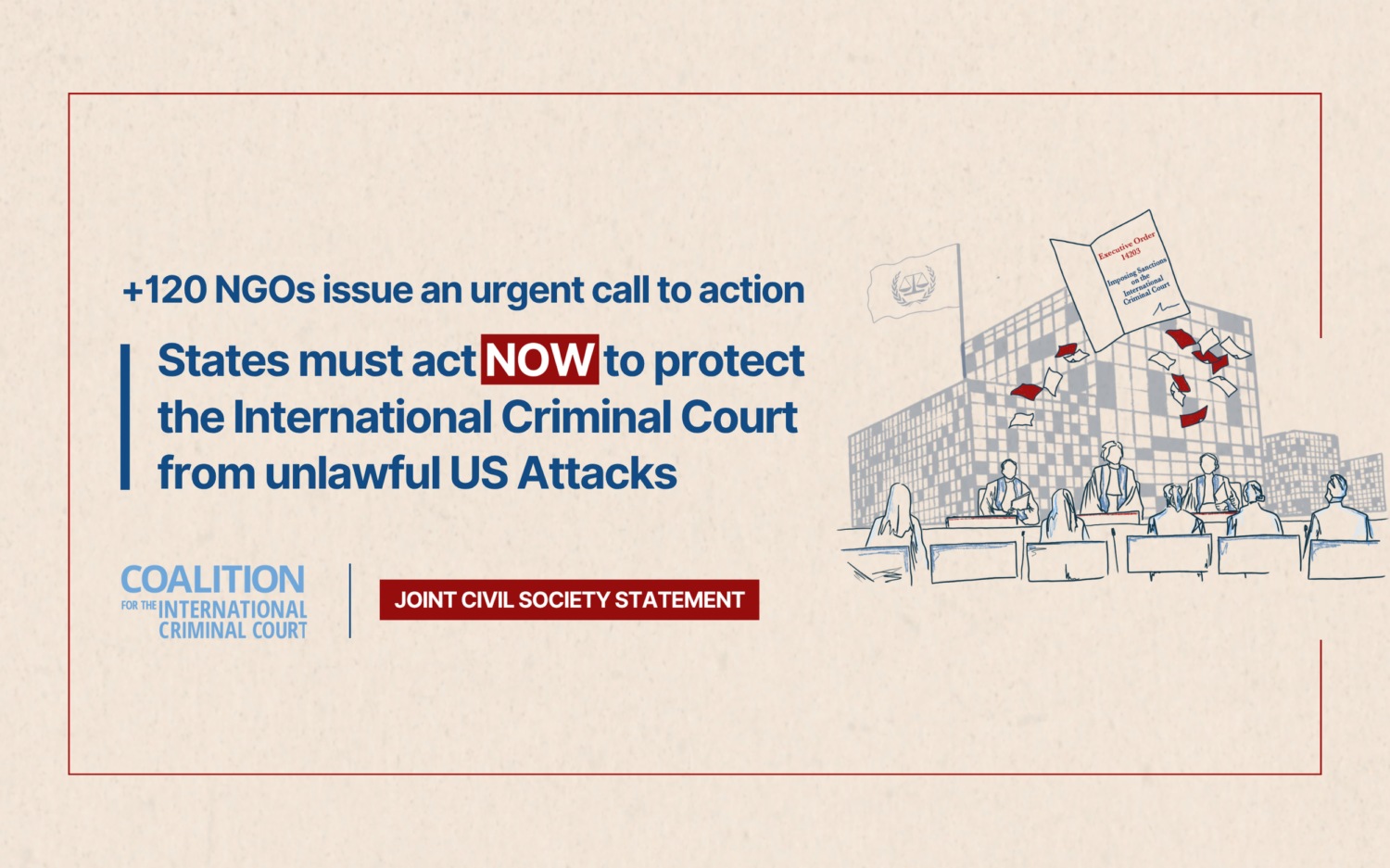
Joint Statement: Urgent Call for Action: States Must Act Now to Protect the International Criminal Court from Unlawful US Attacks
The Coalition for the International Criminal Court (CICC), the more than 120 undersigned organisations from over 60 countries representing all regions, and dozens of legal experts, human rights defenders and members of the European Parliament, condemn unequivocally and in the strongest terms the decision by the United States (US) to impose unlawful sanctions on the International Criminal Court (ICC). This unprecedented measure represents a direct attack against the rule of law, the independence of the Court and international justice, ultimately undermining the rights of millions of victims and survivors of mass atrocities worldwide.
The ICC has shown remarkable resilience in steadfastly discharging its mandate in the face of escalating attacks. Now, States Parties must match this commitment by defending the Court they themselves established and protecting those who cooperate with it. Condemnations alone are not enough; coordinated action is urgently needed to protect the Court’s ability to function.
On 9 October 2026, the US announced the imposition of sanctions against the ICC as an institution under Executive Order 14203. These sanctions mark the gravest escalation in the sustained campaign carried out by the US with the declared aim of dismantling the ICC “brick by brick” for having investigated crimes allegedly committed on the territory of a State Party by US nationals or their allies, in particular Israeli nationals. Under the Rome Statute, the Court may exercise jurisdiction over crimes committed on the territory of a State Party, irrespective of the nationality of the alleged perpetrator.
Since February 2025, the Trump administration has imposed sanctions on the former ICC Prosecutor, Karim Khan; both Deputy Prosecutors; the ICC President and eight other judges; a staff member and judicial candidate; a UN Special Rapporteur; and three Palestinian human rights organisations.
These measures aim to undermine the Rome Statute system as a whole and to prevent the investigation and prosecution of international crimes.
Executive Order 14203 prohibits US persons from providing material support or services to designated persons and entities, including financial services, and exposes non-US persons to the risk of secondary sanctions for engaging in conduct prohibited under the Executive Order. US persons who violate it may face criminal penalties of up to 20 years’ imprisonment and fines of up to 1 million USD, as well as civil penalties.
Although the Executive Order contains a six month wind-down period and exemptions for certain services, significant risks remain. Given the global reliance on the US financial and IT systems, even non-US service providers, including banks, may stop rendering their services to the ICC out of fear of penalties or reprisals from the US Treasury. This could impact the Court’s ability to maintain a bank account, receive financial contributions from States Parties, make payments, pay staff and maintain essential operations.
The Netherlands, as the host country, and all States Parties are responsible for ensuring the ICC can maintain access to services critical to its operations. The Court must be able to continue to carry out its core functions, including investigating alleged crimes; holding hearings; protecting victims and witnesses; and providing legal aid services.
For victims, survivors and witnesses in more than a dozen situation countries under investigation by the Court across the globe, the consequences could be profound. Many have waited years for justice, recounted traumatic experiences and placed their trust in the ICC as a last resort for justice. Any disruption to the ICC’s mandate and operations risks impeding their right to justice. It threatens decades of advances in accountability and justice efforts, leaving victims of war crimes, crimes against humanity and genocide without a meaningful prospect for accountability, truth and reparations.
The sanctions are already undermining justice efforts. The three Palestinian NGOs designated for cooperating with the Court immediately lost access to their bank accounts, funds, IT services and partners, impeding their work. The damage does not end with those targeted; the sanctions have created a chilling effect and impacted freedom of expression and association worldwide. Sanctions on the Court as an institution risk deepening that effect. Ultimately, victims, families of victims and survivors will pay the biggest price.
The US, which is not a State Party, is blatantly attacking the world’s only permanent international criminal court through measures that leverage its position within the global financial system. If the 125 States Parties to the Rome Statute allow these attacks to undermine the Court’s ability to function, the consequences would extend far beyond the ICC, threatening the broader rule of law, states’ sovereignty and systems of justice at the national, regional and international levels.
Statements of concern and condemnations are no longer a sufficient response to this attack. A coordinated response can no longer be delayed. Three decades ago, States made a promise that no one, no matter how powerful, will be shielded from accountability for international crimes. Victims and survivors have waited decades for a Court capable of delivering justice regardless of power or nationality, and today, the ICC is facing unprecedented pressure precisely because it seeks to apply the law equally. States Parties established the Court and are uniquely placed to safeguard its independence and effectiveness. Failure to respond decisively risks weakening the international justice system they pledged to uphold.
The CICC calls on all States Parties, individually and collectively, to:
- Denounce publicly, unequivocally, in the strongest terms possible and at the highest political level the institutional sanctions against the ICC and those cooperating with it as an unlawful attack on judicial independence, the rule of law and victims.
- Immediately adopt or activate blocking measures at the national and regional level – including the immediate adoption of the EU Blocking Statute (Council Regulation (EC) No 2271/96) and equivalent domestic legislation elsewhere – to shield those designated, including the Court and its officials, the UN Special Rapporteur and civil society organisations, from the extraterritorial reach of these sanctions.
- Guarantee that the Court and those cooperating with it can have access to banking and other essential services, including by:
- Providing legal certainty to service providers by taking a clear legal position on the non-extraterritorial application of sanctions and making this legal position publicly available through letters or written statements.
- Engaging proactively and regularly with banks, financial institutions, IT companies and others to reaffirm the unlawfulness of the sanctions, clarify that they should not be enforced extra-territorially, reject over-compliance or de-risking strategies and stop automatic or externalised compliance.
- Ensure that all relevant ministries, including foreign affairs, justice, finance, treasury and digital affairs, coordinate, including at the regional level, to develop whole-of-government solutions.
- Apply protection and solutions equally to civil society, human rights defenders and survivors targeted with sanctions or at risk due to their cooperation with the Court, extending every statement, solution, démarche and funding measure to include civil society organisations designated and those at risk, without distinction.
- Find concrete measures to mitigate the impact of sanctions on civic space, freedom of speech and freedom of association.
- Build and invest in economic, financial and tech sovereignty and resilience to reduce structural dependency on US service providers.
- Explore all possible diplomatic and legal avenues to challenge the sanctions and their legality under international law, including by supporting any legal challenge raised by designated persons in the US and through a referral to the International Court of Justice.
- Publicly and strongly reaffirm their commitment to the Rome Statute and continue to comply fully with their obligations under the Rome Statute, including funding, cooperation and the arrest and surrender of all persons subject to ICC warrants, without exception, delay, or selectivity.
- Publicly and clearly oppose any initiatives aimed at weakening the Court, including attempts to amend the Rome Statute to limit its jurisdiction or independence and attempts to influence prosecutorial priorities, including efforts to sideline specific situations, such as Afghanistan or Palestine.
- Refuse, without exception, coercion by a non-State Party to influence votes, positions, or conduct within the ASP or any other body of the Rome Statute system.
- Ensure any ICC-related meeting is held in a country that ICC officials and staff and civil society organisations, including those designated, can access safely and without threats.
The signatories are:
Organisations
11.11.11
A World Without Chemical and Biological Weapons (WWW)
Action pour le Développement Intégral de l’Homme et de Tout l’Homme au Modèle de Kizito-Anuarite
Action pour la Justice et Promotion des Droits de l’Homme (ARJPDH)
Afghanistan Organization for Development of Human Right (AODHR)
African Development and Peace Initiative (ADPI)
African Initiatives for a Democratic World Order
Al Haq
Al Mezan Center for Human Rights
ALTSEAN-Burma
Amman Center for Human Rights Studies(ACHRS)
Amnesty International
Asia Justice Coalition
Asociación Pro Derechos Humanos
Association Cultures du Monde
Association Marocaine des Droits Humains (AMDH)
The Arab Coalition for the International Criminal Court (ACICC)
Atrocities Watch Africa
Australian Centre for International Justice
Avocats Sans Frontières
Bahrain Human Rights Society (BHRS)
Bangladesh Integrated Social Advancement Programme
Cairo Institute for Human Rights Studies
Center for Civil Liberties
Center for Constitutional Rights
Center for Justice and Accountability
Center for Prisoners’ Rights
Centre marocain pour la loi et la paix
Citizens’ Assembly (Yurttaşlık Derneği)
Civic Committee for Human Rights (CCHR)
Civil Society Institute – Armenia
Coalition Guinéenne pour la Cour Pénale Internationale (CGCPI)
Coalition tunisienne pour la Cour pénale internationale
Collectif de Sauvegarde de la LADDH Algérie
Colombes de la Nature
Comisión de Derechos Humanos de El Salvador
Committee on the Administration of Justice (CAJ, Northern Ireland)
COMPPART Foundation for Justice and Peacebuilding
DAWN
Defence of Human Rights and Public Services Trust
Documenta – Center for Dealing with the Past
Egyptian Initiative for Personal Rights (EIPR)
Exodus Charity Organization
EuroMed Rights
European Center for Constitutional and Human Rights (ECCHR)
FIBGAR – Baltasar Garzon International Foundation
The International Federation for Human Rights (FIDH)
Fondation congolaise pour la promotion de droits humains et la paix
Foundation Sunflowers
Global Justice Center
Groupe LOTUS
Helsinki Citizens’ Assembly Vanadzor
Holistic Empowerment for Development
Human Rights and Humanitarian Development Initiatives
Human Rights Centre ZMINA
Human Rights Now
HuMENA for Human Rights and Civic Engagement
Impact: Center against Human Trafficking and Sexual Violence in Conflict
IMPARSIAL – The Indonesian Human Rights Monitor
İnsan Hakları Derneği/Human Rights Association (İHD)
International Association of Democratic Lawyers (IADL)
International Commission of Jurists
International Commission of Jurists, Norwegian Section (ICJ Norway)
International Community Care e.V.
Kazakhstan International Bureau for Human Rights and Rule of Law
Kenyan Section of the International Commission of Jurists (ICJ Kenya)
Kharkiv Human Rights Protection Group
Kimbé Rèd FWI
Kurdish Organizations Network Coalition for the International Criminal Court (KONCICC)
Kurdistan Organizations Network to Abolish Nuclear and Mass Destruction Weapons (KONW)
Kurdistan Without Genocide
LDH (Ligue des droits de l’Homme/droits humains)
Lebanese Center for Human Rights (CLDH)
Legal Action Worldwide (LAW)
The Legal Agenda
Libya Crimes Watch (LCW)
Liga Mexicana por la Defensa de los Derechos Humanos
Liga voor de Rechten van de Mens
Ligue Pour La Paix, Les Droits De L’homme Et La Justice (LIPADHOJ)
Ligue Sénégalaise des Droits Humains
Ligue tunisienne des droits de l’homme
LingvaLexa
Maldivian Democracy Network (MDN)
MARUAH (Working Group for ASEAN Human Rights Mechanisms, Singapore)
Mnemonic
Netherlands Helsinki Committee
No Peace Without Justice (NPWJ)
Norwegian Council for Tolerance & Peace (NCTP)
Norwegian Helsinki Committee
Observatorio Ciudadano
Orde van Vlaamse Balies
Ordre français des avocats du barreau de Bruxelles
Organization Against Weapons of Mass Destruction in Kurdistan
Organisatión Nationale des Droits de l’Homme du Senegal (ONDH)
Organization of the Justice Campaign (OJC)
Palestinian Association for Human Rights (Witness)
Palestinian Centre for Human Rights (PCHR)
The Palestinian Human Rights Organization (PHRO)
PAX
Philippine Alliance of Human Rights Advocates (PAHRA)
Philippine Coalition for the International Criminal Court (PCICC)
Philippine Human Rights Information Center (PhilRights)
Platform for Peace and Humanity
The Public Committee Against Torture in Israel
REDRESS
Refugees in Libya – APS
Reporters Without Borders (RSF)
Rights for Peace
Robert & Ethel Kennedy Human Rights Center
Rohingya Maìyafuìnor Collaborative Network
Route Justice
StoptheDrugWar.org
Students for Global Democracy Uganda
Swedish Peace and Arbitration Society (SPAS)
Synergy for Justice
Syrian Center for Media and Freedom of Expression (SCM)
TRIAL International
Union for Civil Liberty (UCL)
United Nations Association Sweden
Vision GRAM-International
Vous et Vos Droits
Women’s Initiatives for Gender Justice (WIGJ)
World Organisation Against Torture (OMCT)
World Without Genocide
Young World Federalists
Youth Compassion for Humanity Uganda
Youth for Peace and Dialogue between Cultures
Zarga Organization for Rural Development
Zimbabwe Human Rights Association
Individuals
Ahmed Aloui, Association tunisienne de défense des libertés individuelles
Nadia Attaire, JURDI
Farhatullah Babar, Human Rights Cell, Pakistan Peoples Party
Andrés Mauricio Balcázar Suárez, Colectivo de Abogados José Alvear Restrepo
Edgar Boydens, Former Dean of the Brussels Bar
Estelle Ceulemans, Member of the European Parliament
Christophe Clergeau, Member of the European Parliament
Rafendi Djamin, Human Rights Working Group (HRWG), Indonesia’s NGO Coalition for International Human Rights Advocacy
François Dubuisson, Université libre de Bruxelles
Terje Einarsen, University of Bergen
Penelope Faulkner, Quê Me: Vietnam Committee on Human Rights (VCHR)
Benjamin Fiorini, Université Paris 8
Claire Fita, Member of the European Parliament
Isabelle Fouchard, CNRS/Université Paris 1 Panthéon-Sorbonne
Raphaël Glucksmann, Member of the European Parliament
Sandra Gómez López, Member of the European Parliament
Pierre Jouvet, Member of the European Parliament
Sarah Kasande, International human rights lawyer
Murielle Laurent, Member of the European Parliament
César Luena, Member of the European Parliament
Mathilde Lutak, JURDI
Kaari Mattila, Academic
Nora Mebarek, Member of the European Parliament
Alessandra Moretti, Member of the European Parliament
Hana Jalloul Muro, Member of the European Parliament
Matjaz Nemec, Member of the European Parliament
Aodhán Ó Ríordáin, Member of the European Parliament
Zoran Pusić, Civic Committee for Human Rights (CCHR)
René Repasi, Member of the European Parliament
Insaf Rezagui-Sbeih, Université Paris Cité; JURDI
Chloé Ridel, Member of the European Parliament
Indira Rosenthal, Independent
Farah Safi, JURDI
Sarah Sameur, Avocate au Barreau de Paris
Joanna Scheuring-Wielgus, Member of the European Parliament
Eric Sargiacomo, Member of the European Parliament
Krzysztof Smiszek, Member of the European Parliament
Cecilia Strada, Member of the European Parliament
Tineke Strik, Member of the European Parliament
Marta Temido, Member of the European Parliament
Vesna Teršelič, Antifascist League
Thomas Verfuss, Journalists For Justice
Luc Walleyn, Lawyer
Tiemo Wölken, Member of the European Parliament
Lara Wolters, Member of the European Parliament
Dr Parisa Zangeneh, Independent
Mounir Satouri, Member of the European Parliament