
REDRESS Joins International Human Rights Observation Mission in Spain to Monitor Accountability for Rubber Bullet Injuries
Members of the United Against Torture Consortium, REDRESS and OMCT, will participate in an international human rights observation mission in Barcelona to monitor the trial, which begins today, concerning the serious injuries suffered by demonstrator Roger Español during the 2017 Catalan referendum. Español lost his sight in one eye after being struck by a rubber bullet fired by a member of the Spanish National Police.
Four National Police Officers are facing the proceedings in connection with the incident. The case raises fundamental questions concerning the lawfulness and proportionality of the use of force by law enforcement officials, the accountability of police officers and commanders for serious injuries, and whether the facts constitute torture and aggravated intentional bodily harm.
REDRESS will attend the hearings as part of our ongoing work to challenge torture, ill-treatment and the excessive use of force by law-enforcement officials during peaceful protests. The international observation mission also includes OMCT, INCLO, Amnesty International, the ICHRP–Spain, and DqD.
“Less-lethal does not mean harmless. Rubber bullets can cause devastating and permanent injuries, and when police use excessive force against protesters it can amount to torture or other ill-treatment under international law, as the European Court of Human Rights has found in other cases. Victims deserve justice, and those responsible must be held accountable,” said Ana Cutts Dougherty, REDRESS Legal Officer.
The mission will assess whether the proceedings meet national and international standards relating to victims’ access to justice and reparation, fair trial guarantees, accountability for serious human rights violations, and the protection of the right to peaceful assembly.
The mission considers that allegations of torture committed in the context of public demonstrations require effective, independent, and impartial judicial scrutiny. The right to peaceful assembly is protected under international human rights law and is closely connected to freedom of expression and political participation. States have an obligation not only to respect this right, but also to facilitate its exercise. While law-enforcement authorities may take measures to protect public order, this does not give them unrestricted powers to use force against people exercising their right to peaceful assembly. Where the use of police force causes serious injury, the circumstances surrounding its use must be effectively investigated. Where the evidence establishes criminal responsibility, those responsible must be held accountable.
So-called “less lethal” weapons, including rubber bullets, tear gas, and other crowd-control devices, are often presented as safer alternatives to firearms. However, when misused or deployed contrary to international standards, they can cause devastating injuries, permanent disabilities and, in some cases, death. Their use by law-enforcement authorities must therefore be assessed against the principles of legality, necessity, proportionality and precaution, as well as international standards.
As part of the United Against Torture Consortium (UATC), REDRESS continues to work with partners worldwide to support victims and advocate for stronger safeguards against torture, ill-treatment and the misuse of police force. The UATC has published Protesting Without Fear, which outlines measures States can take to safeguard against torture and other ill-treatment during protests, and Challenging Repression, a practical guide to documenting and challenging the misuse of police weapons. The UATC has also used legal interventions to advance accountable policing, including by intervening in Theron v France, the first European Court of Human Rights case concerning the use of explosive grenades against protesters, and by filing a UN complaint concerning a human rights defender from Western Sahara who suffered severe injuries during a peaceful protest.
The observation mission represents another important opportunity to reinforce these efforts and to advance accountability where torture is alleged.
For more information, please contact Eva Sanchis, Head of Communications, on [email protected] or +44 (0)20 77931777.
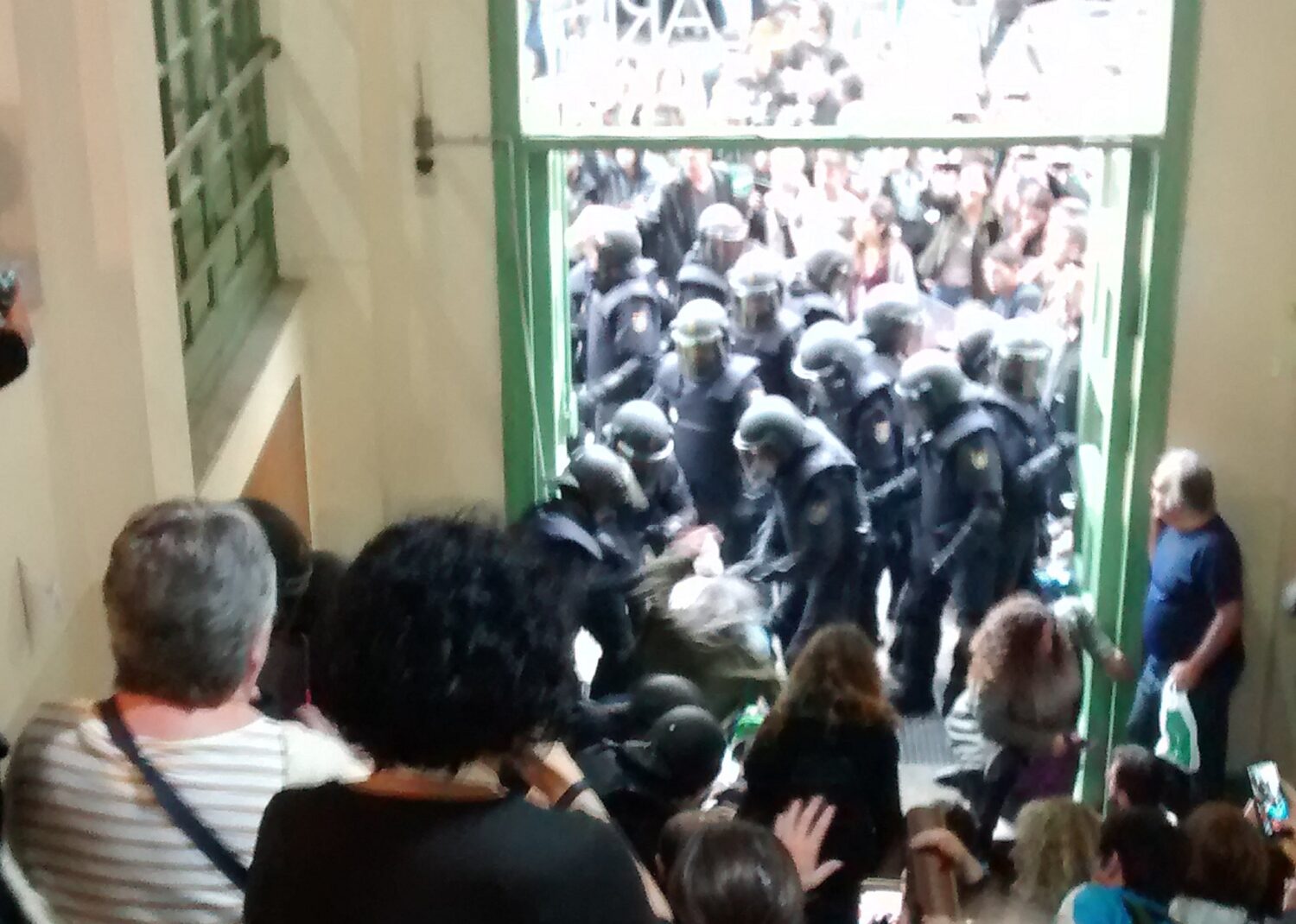
Photo by Agapito (CC BY-SA 4.0). Police intervention at Pau Clarins Institute in Barcelona during the referendum of 1 October 2017 in Catalonia.