
‘Sangamam’ – Rebuilding Hope that the State Shattered
by Edgar Kaiser, Grassroots human rights defender from People’s Watch and REDRESS Innovative Lawyer Awardee
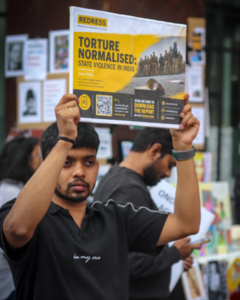 In June 2025, REDRESS published its report, ‘Torture Normalised: State Violence in India’, unravelling how torture is routine in the country. India is among a handful of countries in the world that have neither ratified the United Nations Convention Against Torture nor enacted an anti-torture law to ensure accountability. Survivors and victims who must be at the heart of the criminal justice system are virtuallyinvisible, leaving them with little to no reparation avenues.
Beyond financial compensation, States should address the profound consequences of torture through restitution, social reconciliation and empower victims and survivors. This is exactly what People’s Watch,an Indian anti-torture organisation, is accomplishing in an environment fraught with systemic impunity and no place for survivors in the criminal justice system.
‘Sangamam’ is a Tamil word, meaning ‘coming together‘. Unlike the common practice of providing reparation for the survivors who were directly affected, this initiative by People’s Watch and its partner organisations is for children belonging to families that endured violence. It is a rehabilitative annual summer campthat brings together children whose parents either were arbitrarily detained, tortured or even subject to extrajudicial killings at the hands of state agents. Many of these children belong to certain communities called ‘Kalottar’ and ‘Kattu Naicker’, commonly referred to as Denotified Tribes (DNTs), who were once branded as “criminal tribes” under the British colonial-era law, the Criminal Tribes Act of 1871. They were denotified and freed from the draconian law after independence, but the systemic violence and stigma traversed through time.
In a system that doesn’t even recognise direct victims, children, who undergo second-hand trauma and suffer the material damage of the loss of the breadwinner, have nowhere to go but for ‘Sangamam.’ An experiment that started with a few children in 2002 grew into an annual camp that facilitates more than children every year. For over 20 years now, the camp has brought back the delight of childhood in the lives of thousands of children, restored hope that was shattered by the state and reminds them ‘they’re not alone. The camp is filled with art and craft, photography, sports, motivational sessions, career counselling, trips to hill stations, and even something as simple as three nutritious meals a day, all that they had longed for, and all that every child rightfully deserves. Besides the children from denotified communities, there are children whose parents were unlawfully killed by the State; one such is the Sheshachalam encounter. While their families have awaited justice for over 15 years now, this camp gives them what the State has refused: reparation.
But the best part of the camp is how it has transformed victims into leaders of the movement today. In a documentary film, Thangeshwaran, whose father was shot dead by the police in 1997 and attended the first ‘Sangamam’ in 2002, poignantly recalls how he eagerly waits for this camp every year to forget all his sorrow and how this has transformed him from a beneficiary to a volunteer to a yoga teacher at the camp now after 25 years. Advocate Karunanidhi, whose father was illegally detained and subject to ill-treatment, is another beneficiary of the camp in 2003 who now advancesthe cause before Indian courts and was invited by the US Department of State for an exchange program focused on the rule of law. “Prabhakaran, who also attended the first camp in 2002 and who himself was subject to arbitrary detention in 2001, now leads a child rights organisation funded by UNICEF”.
Jayakumar was only 22 when he was brutally tortured by the police, leaving him with temporary kidney failure. People’s Watch’s swift intervention saved his life by ensuring urgent medical care. His fight for accountability reached the Supreme Court, where he was represented by Retd. High Court Chief Justice (Odisha) S. Muralidhar, now Chair of the UN Independent International Commission of Inquiry on the Occupied Palestinian Territory. Although the Court denied him the relief he sought, Jayakumar survived. Today, he returns to Sangamam every year, not as a victim, but as a volunteer. These stories are a stark reminder that when justice eludes the victims in a climate of systemic impunity, it is organisations like these that continue to ensure that survivors and victim families receive the holistic reparation they deserve.
This article was first published in the Community Corner of our Just Reparation newsletter. These contributions are invaluable in enriching our collective understanding and fostering meaningful dialogue within the reparation community of practice. If you would like to be featured, we encourage you to submit your contributions to [email protected].