
Tradition, Torture and Tear: Unveiling the Cycle of Abuse in Hijra Community
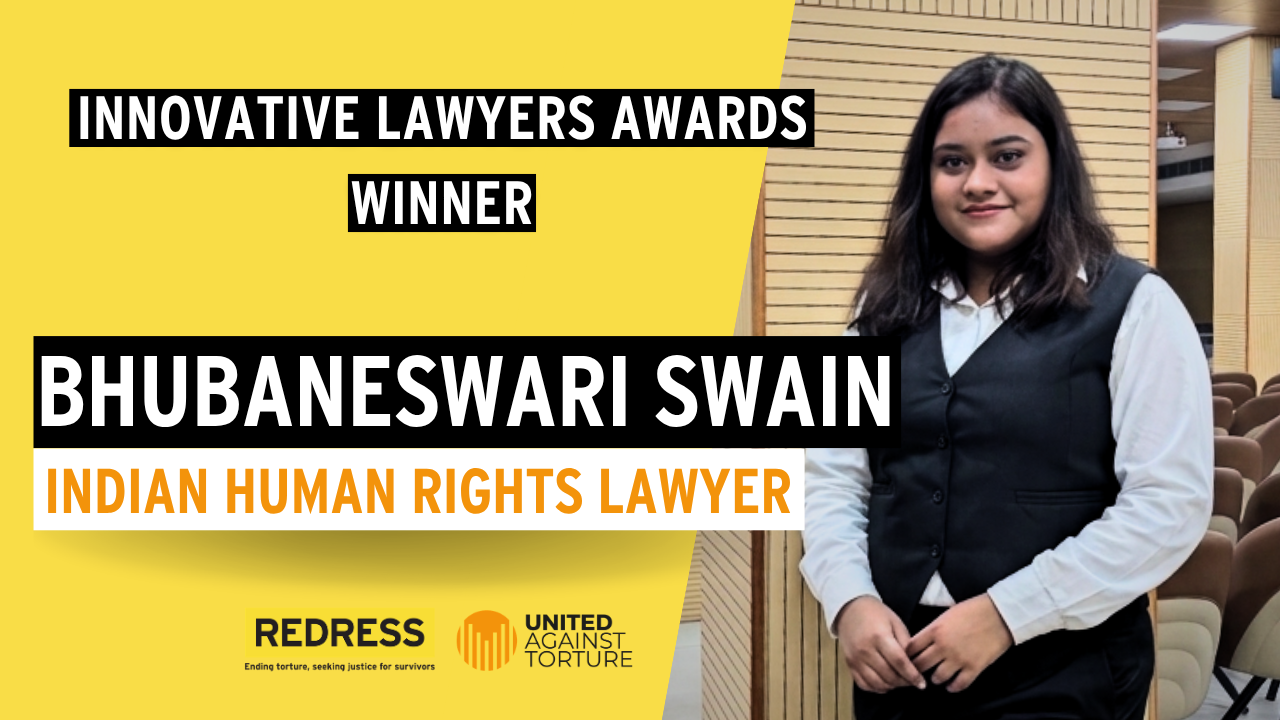
By Bhubaneswari Swain, ILA Awardee
Bhubaneswari Swain is an Indian human rights lawyer and winner of the REDRESS Innovative Lawyers Awards. She is an activist with Safe Odisha For Her, an initiative that seeks to transform a village into a model violence-free community by addressing deeply rooted caste- and gender-based violence. Through her work, she leads campaigns promoting the rights of women and LGBTQ+ communities in both rural and urban areas, while also coordinating legal literacy programmes to raise awareness of constitutional rights and protections.
In her blog, Bhubaneswari reflects on the systemic marginalisation, discrimination, and abuse faced by the Hijra community in India. She examines the barriers the community continues to encounter despite important legal advances and calls for greater social acceptance, stronger legal protections, and increased accountability for human rights violations.
The Hijras in South Asia (including India) are a distinct third-gender community encompassing individuals who undergo emasculation (‘nirvana’), transgenders, and intersex persons who voluntarily enter a structured kinship system built around the Guru-Chela relationship. The formal adoption of a ritual through which the Guru – the guardian of the Hijras – accepts an individual’s entry into the community makes a person a Hijra. Despite being accorded the sacred position in Hindu mythology and the noble status as tax collectors and court officials during the Mughal period, Hijras have long faced social exclusion, marginalisation and discrimination. Although many enter the kinship structure for safety, protection and community belonging, internal hierarchy and the authority exercised by the Gurus often force the Hijras into debt bondage, beggary and sex trafficking, leaving an estimated half a million Hijras in India living within a dual reality.
This dual reality is deeply reflected in India’s legal history, marked by a constant tension between state-sanctioned violence and judicial progress. Rooted in the colonial Criminal Tribes Act of 1871, which institutionalised surveillance and abuse, this systemic vulnerability persisted long after independence. A major breakthrough came with the Supreme Court’s landmark , which recognised a “third gender” and affirmed the right to self-determination. This was followed by the Navtej Singh Johar (2018) ruling, which decriminalised homosexual relationships that had historically been weaponised by police to facilitate extortion and harassment. However, recent legislative developments have heavily undermined these judicial milestones. The Transgender Persons (Protection of Rights) Act of 2019 and its recent 2026 amendment dismantled the self-identification standard by mandating bureaucratic district magistrate certification and invasive medical procedures. In direct violation of NALSA and international frameworks like the Yogyakarta Principles (Principle 31(iii)), these laws have forcibly shifted the Hijra identity from a deeply personal and culturally rooted right into a strict medical construct subject to state gatekeeping.
Whenever I think of the Hijar community, words such as ritualised marginalisation, institutional torture, social stigma and exclusion come to my mind. Hijra is a community of eunuchs in India. They are basically a woman’s mind in a male body or intersex persons who have been blacklisted from society for their gender identity. Their existence is no ‘malfunction’; it is a biological reality as ancient as the human genome. This community has experienced immense suffering and faced sustained marginalisation across different historical periods, which intensified during the medieval period and colonial rule. Society has changed, yet the violence faced by Hijra community has remained tragically static. They remained socio-economically exiled and institutionally scarred.
Beyond the Traffic and Red Light
Historically, the Hijra community held significant roles as caregivers in the Mughal courts and sacred harbingers of blessings in Hindu tradition. However, these roles expose the dual face of patriarchy and reflect a contradiction. On the one hand, people want ‘divine’ satisfaction, while on the other hand, the same people enforce their social isolation. By treating them as spiritual tools for entertainment rather than human beings with rights, society has trapped the community in a cycle of transgenerational trauma.
As this community has been denied basic rights and they do not have a formal occupation and are mostly involved in begging and prostitution, the Hijar Community is facing a continuous cycle of torture. Such discrimination led to massive inequality. From identity to availing constitutional rights, they waged war from 1990s and finally through judicial intervention, in the case of NALSAV. Union of India (2014), the Law of India allowed this marginalised community to get recognition as citizens of India, and this recognition resulted in reports of crimes unveiling the true story of the Hijra community who are often associated with Traffic Light and Red Light.
Who Guards the Guardians?
The police are responsible for upholding law and order, but serious concerns arise when those responsible for protection become perpetrators of abuse. While it is often suggested that individuals seek remedies through the courts, in practice, this can be difficult for such marginalised communities, especially when government authorities are involved in abuse. Barriers include limited access to legal support, fear of retaliation, and attempts from authorities to tamper with evidence, as well as structural patriarchal issues in society that contribute to discrimination.
Due to the broad powers granted to police officers, abuse of authority is commonly reported, and members of the Hijra community are not exempt from this risk. Occupations like begging and sex work may place them in a circumstance of special vulnerability, where they are frequently affected by crimes such as extortion, theft, rape, and murder. Previously, due to a lack of proof of citizenship, their cases were usually never registered by the police. To seek protection, they often gave a percentage of their income to local officers, who nonetheless provided no guarantee of safety. Furthermore, if any member of this community is accused of a crime, they become prime victims of custodial torture due to the lack of identity proof, the true number of custodial deaths remains unknown.
Lighting the Shadows: My Journey Towards Bringing Acceptance and Inclusion
Universal acceptance and inclusion can only help us eradicate institutional and societal abuse of this community. Through my awareness programmes and workshops, I came to the conclusion that bringing change is not an impossible task. For instance, Galileo Galilei was tried and was sentenced for arguing that the sun is a motionless object while the Earth revolves around it, but later the same theory was universally recognised. Likewise, I believe if we start explaining the biopsychosocial concept of gender in a simplified way, it would be easier for people to understand why communities like Hijra exist and why we should give equal respect and role in society, and help them to fight against a structurally discriminatory system.
A recent case illustrates what accountability can look like. A Hijra person was brutally killed while carrying out their profession of prostitution. Due to significant advocacy and public awareness efforts, the community fought strongly, and within days, the perpetrators were arrested, and legal proceedings are ongoing.
Beyond the physical violence, the legal and constitutional rights of the Hijra community continue to receive insufficient attention. Though the Apex Court has given its verdict to protect the constitutional rights of the trans community, the ambiguity still veils access to such rights. While the law never bans Hijras from inheriting their father’s property, the lack of specific recognition in personal laws creates significant, systemic barriers that often prevent Hijras from inheriting their father’s property.
Abuse directed against any segment of society reveals a profound vulnerability in our shared humanity. To end this cycle of violence, we must commit to collective efforts that prioritise rights awareness and rigorous oversight of legal remedies. Only by bridging the gap between constitutional promises and ground-level reality can we ensure that the Hijra community is protected from systemic shifts in power and finally granted the full dignity of citizenship.
About the Innovative Lawyers Awards
REDRESS’s Innovative Lawyers Awards recognise the vital work of new and emerging anti-torture champions, expose them to a broader peer support network, provide financial support to pursue public interest litigation and to inspire other lawyers and practitioners. This support is made available through the United Against Torture Consortium, which is funded by the European Union. The contents of the Innovative Lawyers Awards blog series are the sole responsibility of the authors and do not necessarily reflect the views of the European Union or REDRESS.