
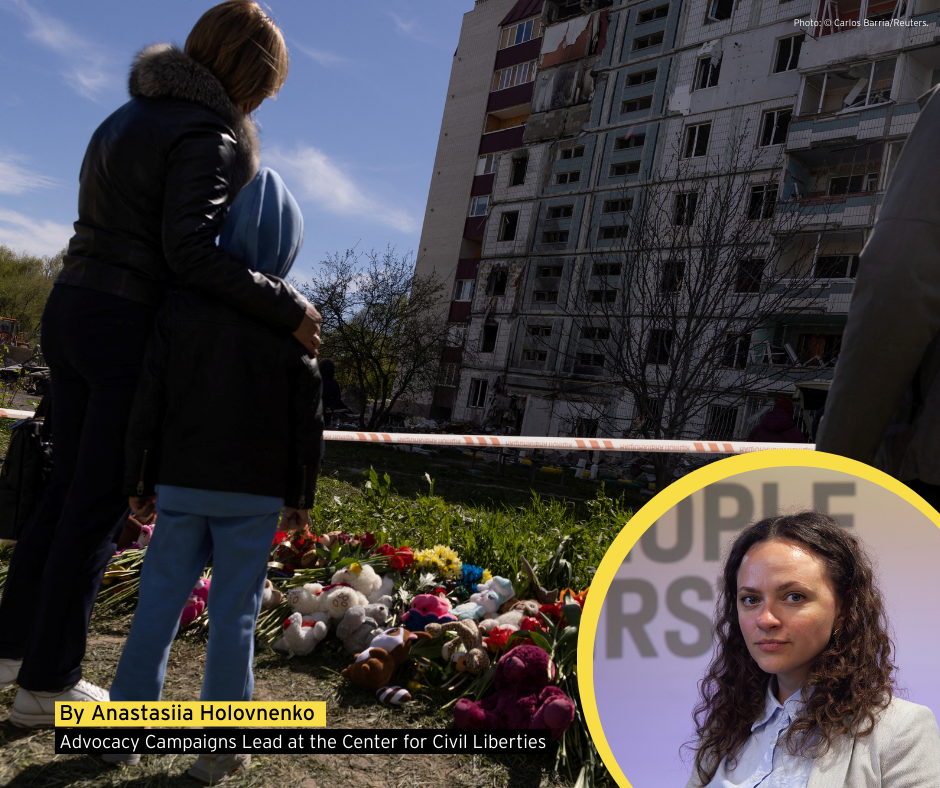
War Has Names — Principles Must be Enforced
By Anastasiia Holovnenko, Advocacy Campaigns Lead at the Center for Civil Liberties
For Western readers, Ukraine is often framed as a foreign war. In reality, its costs for other countries are already felt in energy bills, migration pressures, defence budgets, and the erosion of the rules meant to prevent wars like this in the first place.
“When they ask me what war is, I answer without hesitation: it’s names.” — Maksym Kryvtsov, Ukrainian poet and volunteer, killed in action on 7 January 2024.
These words explain war more precisely than any statistics ever could. Because war is not an abstraction. It is always about specific people, specific lives, and specific responsibility.
Since 2014, and especially following Russia’s full-scale invasion on 24 February 2022, Ukraine has become a site of systematic and widespread violations of international humanitarian law and human rights. Deliberate attacks on civilians, torture, extrajudicial executions, sexual violence, forced deportations, and the destruction of residential neighbourhoods, hospitals, schools, and energy infrastructure are not “tragic consequences of war.” They are documented crimes.
Reports by UN monitoring missions make this clear: the majority of victims are civilians — people killed in missile and artillery attacks on residential areas, markets, transport, and infrastructure built for life, not for war. The number of civilians killed and injured already amounts to tens of thousands. The deadliest year for civilians remains 2025, during which more than 2,500 civilian deaths and over 12,000 injuries were verified — the highest toll since the start of the full-scale invasion. These figures remain underestimates due to the limited access to occupied territories.
In cities like Mariupol or Izium, entire neighbourhoods were erased. Homes were not just destroyed; property records, savings, businesses, and futures were wiped out overnight. Without compensation, there is no realistic path back.
Millions of people have lost their homes, their livelihoods, and access to education, healthcare, and basic services. Direct damage to civilian infrastructure is estimated in the hundreds of billions of US dollars, while reconstruction needs exceed half a trillion dollars.
Yet behind all these numbers are not charts or graphs. They are names.
Children who will never see their parents again.
Parents forced to bury their own children.
Families left without a home.
Older people deprived of heat and essential medicines.
Businesses and entire communities wiped off the map.
This is precisely why reparations are not an internal matter for Ukraine alone. They are a test for the entire international system.
First, compensation is a cornerstone of the international legal order. When a state that launches an aggressive war and commits mass crimes bears no material responsibility, international law loses its meaning. War becomes economically profitable, and impunity turns into a new norm. This undermines the very architecture of security established after the Second World War.
Second, reparations are a tool of deterrence. When the destruction of cities and civilian lives carries no real cost, the signal is heard far beyond Moscow. It is received by authoritarian regimes around the world that are closely watching how the international community responds. The absence of compensation today is an invitation to new wars tomorrow.
Third, without reparations, the burden of reconstruction is shifted onto taxpayers in democratic countries. When the aggressor does not pay, victims and their partners are forced to bear the costs of the crimes committed against them. This shifts the burden from the perpetrator to victims and their partners, undermining the very notion of justice.
Fourth, timely reparations are directly linked to Europe’s stability. Without them, recovery is delayed, millions of people are unable to return home, and migration, social, and economic pressures continue to grow. This is not a challenge of the future — it is a reality of today.
Finally, there is a human dimension to time itself. For victims, justice delayed for years means living in prolonged trauma, poverty, and uncertainty. Without compensation, it is impossible to rebuild a home, receive medical treatment, return to work, or restore a community. Justice that arrives too late ceases to be justice.
That is why reparations are not an issue for some distant future negotiations, nor a subject of political bargaining. They are a legal, moral, and security obligation that must be acted upon now.
So, Western governments do not need new principles. They need the courage to enforce the ones they already claim to defend.
Photo: © Carlos Barria/Reuters.