We use strategic litigation and survivor‑centred policy advocacy in the UK to secure justice and reparation for survivors and hold perpetrators accountable.
We do this through representing survivors in legal claims, initiating prosecutions, policy advocacy to the UK government on issues relevant to the absolute prohibition of torture, holding the UK government to account for any alleged complicity in torture, working with communities and survivors on their priorities, and through the use of human rights sanctions.
We provide direct representation to UK-based clients (and their families) who are seeking reparations for torture and ill-treatment suffered in different countries around the world. Those cases are being pursued in regional human rights bodies or through the UN. In addition, we offer support to a few clients in domestic legal processes.
More information about our cases can be found on ourDatabase of cases.
We combine our casework with other civil society techniques such as advocacy, media, and activism to ensure there is implementation after the judgment, a community behind the client, and a cause beyond the case.
We accompany survivors through the legal process and ensure they can access the medical and psychological services they require.
Our recent work includes:
We drew attention to ongoing impunity for serious human rights abuses committed during counterterrorism operations after 9/11. These efforts led to resolutions from the Committee of Ministers of the Council of Europe and the UN Working Group on Enforced and Involuntary Disappearances, finding that Lithuania has failed to investigate violations in relation to the case of our client, MustafaAl Hawsawi, who remains detained at Guantánamo Bay.
We work with the Metropolitan Police and the Crown Prosecution Service to support investigation and prosecutions for the criminal offence of torture, on the basis of universal jurisdiction.
Our recent work includes:
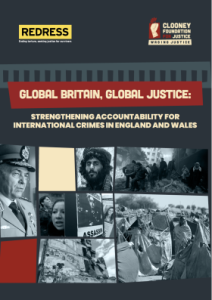
We published a major report with the Clooney Foundation for Justice, “Global Britain, Global Justice,” examining the under-utilisation of universal jurisdiction in the UK. The report contributed to the introduction of a Private Member’s Bill in Parliament and prompted Baroness Kennedy and Lord Alton to introduce amendments to the International Criminal Court Act 2001 in the House of Lords. These amendments would allow the prosecution of non-citizens and non-residents present in the UK who are suspected of genocide, crimes against humanity, or war crimes.
We work to ensure that the international prohibition against torture is maintained by the UK government, and that the UK is held to account for any involvement in torture and ill-treatment, wherever that may occur.
Our recent work includes:
In the case of our client, Mustafa Al Hawsawi, who remains detained at Guantánamo Bay, we litigated a case before the UK’s Investigatory Powers Tribunal and obtained a judgment from senior UK judges who, for the first time, clarified what it means for UK intelligence services to be “complicit” in torture or other ill-treatment by foreign States during intelligence operations.
We support various clients (and their families) who have faced challenges in accessing appropriate protection from the UK Government, and we have a long history of engaging with the Foreign, Commonwealth, and Development Office (FCDO) on these issues.
We continue to undertake research and analysis on the drawbacks of the present discretionary system, and continue to seek ways of ensuring that protection is available for British nationals who have suffered, or are at risk of, torture and ill-treatment in detention overseas.
Following written and oral submissions by REDRESS, the Australian Senate published a report on consular assistance that relied heavily on the recommendations made by REDRESS.
Following written submissions by REDRESS, which shed light on the devastating impact of State hostage-taking on survivors and their families, the UN Special Rapporteur on Torture produced a reporton hostage-taking, which recognised that it can amount to torture. She also supported REDRESS’s call for States to officially recognise arbitrary detention for leverage as hostage-taking and create national teams specifically tasked with managing these cases.
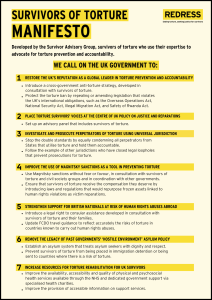
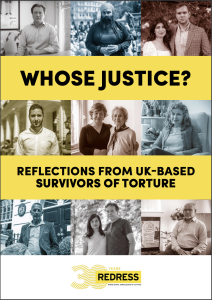
As part of our survivor-centred approach,REDRESS hasbeenfacilitatinganetworkof UK-basedsurvivors of torturesince 2022, known as the Survivor Advisory Group (SAG). The SAG’s main prioritiesare protecting the absolute prohibition of torture and putting survivors’ voices at the centre of domestic legislative and policy proposals. Together with the SAG, we created a UK Anti-Torture Coalition, composed of ten human rights organisations, and campaigned for the UK to once again make the prohibition of torture a priority.
Our recent work includes:
Amplifying survivor voices through a dedicated campaign urging the UK Government to prioritise anti-torture measures and ensure the inclusion of survivors’ voices in shaping government policy.
Jointly hosting (with the SAG and the All-Party Parliamentary Human Rights Group)adiscussion in Westminster on how the UK can align its domestic laws with its international obligations to prevent torture. The event featured remarks from Dr Alice Edwards, the UN Special Rapporteur on Torture, ahead of the UK’s review before the United Nations Committee against Torture due in 2026/7.
The development of nine key principles that underpin our commitment to being survivor-centred across all work areas, including the three main techniques used to challenge torture and deliver impact: (1) strategic litigation, (2) policy advocacy, and (3) media and communications. These principles fall into three categories: working with survivors, representing survivors, and accompanying survivors.
We advocate in the UK to strengthen protection for British nationals detained abroad, to uphold the absolute prohibition of torture in UK law, and to pursue accountability for human rights violations by bringing cases against perpetrators living in the UK.
Our recent work includes:
Raising concerns about provisions of theNational Security Bill that would risk diluting the prohibition of torture in UK law,
Advancing recommendations to improve the UK Government’s approach to hostage diplomacy, which were echoed by the UK Parliamentary Foreign Affairs Committee, and setting out key principles to shape a new legal right to consular assistance for British nationals detained abroad.
We submit requests to the Sanctions Team of the FCDO for the UK to impose“Magnitsky” sanctionson those responsible for torture, co-ordinating with the US and EU regimes for sanctions. We also act as Secretariat for the UK All-Party Parliamentary Group on Magnitsky sanctions, which seeks to raise the profile of the UK regime and ensure effective use of sanctions.
Our recent work includes:
Following a Westminster Hall debate in the UK Parliament promoted by REDRESS on ‘countering Iran’s illicit activities in the UK’, UK Government Ministers committed to referring UK Iran sanctions breaches by banks to the Financial Conduct Authority.
We made five submissions to the Independent Investigative Mechanism for Myanmar (IIMM) exposing UK entities suspected of financially supporting the Myanmar military in its commission of international crimes.