
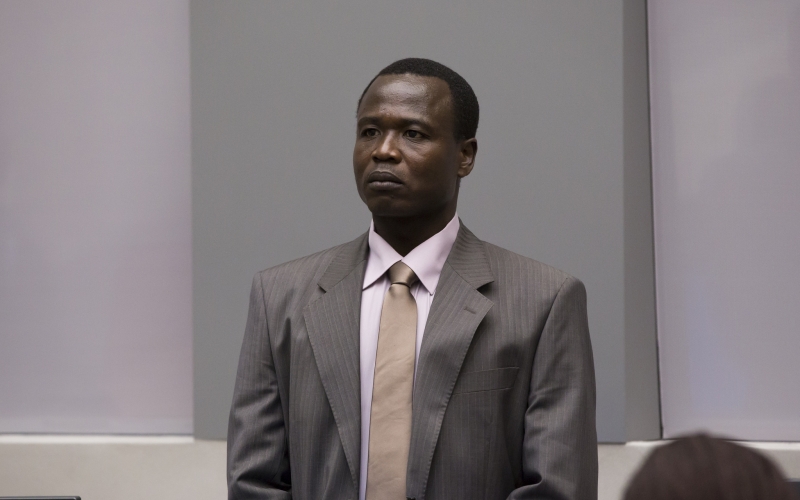
Dominic Ongwen (third-party intervention)
Dominic Ongwen, a former commander of the Lord’s Resistance Army (LRA), was convicted by the International Criminal Court (ICC) of 61 counts of crimes against humanity and war crimes carried out in northern Uganda between 1 July 2002 and 31 December 2005. Following his conviction, the largest Reparations Order was issued by the ICC, awarding reparations to thousands of victims of his crimes.
Case Background
The conflict between the LRA and the Ugandan Government, which lasted from 1986-2006, was one of Uganda’s most devastating conflicts. The LRA is estimated to be responsible for more than 100,000 deaths, the abduction of over 30,000 children, and the displacement of 2.5 million people. Dominic Ongwen, who himself was abducted as a child, became a senior commander of the LRA.
The ICC’s Office of the Prosecutor issued five arrest warrants against LRA leaders, but obtained custody of only Dominic Ongwen, after he surrendered himself to security forces the Central African Republic in 2015. His trial began in 2016, on 70 charges of war crimes and crimes against humanity, including forced marriage, rape, sexual slavery, enslavement and forced pregnancy, torture, murder and attempted murder, attacks against the civilian population, pillaging, persecution, and destruction of property committed during LRA attacks on four camps for Internally Displaced Persons (IDPs) – Pajule, Odek, Lukodi, and Abok. Over 4,000 victims participated in the trial.
On 4 February 2021, the ICC Trial Chamber IX found Ongwen guilty of 61 counts of war crimes and crimes against humanity committed as a senior LRA commander between 1 July 2002 and 31 December 2005. On 6 May 2021, Ongwen was sentenced to 25 years in prison, and on 28 February 2024, the Chamber issued its largest Reparations Order.
Intervention
On 4 February 2022, REDRESS and nine other Ugandan and international organisations submitted a third-party intervention (also called “amicus”) requesting the ICC to put Ugandan victims at the centre of reparations proceedings. Specifically, our submission:
- stressed the importance of delivering prompt and effective reparations to victims and survivors.
- requested the ICC to consider how its own reparation orders could be replicated or complemented by national efforts in Uganda, acknowledging that despite the adoption of a National Transitional Justice Policy in 2019, victims of the broader conflict have largely received no reparations.
- highlighted the need to adopt a victim-centred methodology for the design, identification, and implementation of reparations. The submission indicated measures to enable victims to participate effectively, including making available adequate legal representation, psychosocial support, information about services, care provisions for children, and transportation allowances to victims.
- requested the ICC to adopt an approach that facilitates the identification of victims in light of obstacles they may face as a result of the crimes suffered. For example, we suggested the ICC should apply a presumption that children born from the victims of sexual violence are to be considered direct victims for the purpose of reparations.
- asked the Court to consider ordering the establishment of a mechanism that would allow the ICC Trust Fund for Victims and/or the Registry (the Court’s administrative arm) to identify additional beneficiaries of some of the reparation orders made by the Chamber in the Ongwen case, in consideration of the difficulties that displaced victims face.
Outcome
On 28 February 2024, the Trial Chamber ordered reparations to victims of Ongwen’s crimes, which was confirmed by the Appeals Chamber on 7 April 2025.
This is the largest Reparations Order in the ICC’s history, with a total amount of 52,429,000 EUR to provide reparations to approximately 49,772 direct and indirect victims. The ICC ordered the following reparations to victims:
- An individual symbolic (not compensatory) payment of 750 EUR to all victims, totalling approximately 37,329,000 EUR.
- Collective, community-based rehabilitation programmes, which might include education, vocational training, or access to healthcare, totalling approximately 15 million EUR.
- Community symbolic and satisfaction measures, such as apologies, monuments, memorial prayers, cleansing ceremonies, reconciliation ceremonies, and other human rights sensitisation activities or trainings, totalling 100,000 EUR.
The ICC identified community-based reparations as the most appropriate modality to address the multi-layered harms suffered by the victims, and the only viable option for prompt implementation given the overwhelming number of victims in this case.
Read more in our Briefing Paper: Survivor-Centred ICC Reparations for Victims of Dominic Ongwen’s Crimes.
Ongoing Implementation
With the delivery of the Reparations Order, thousands of victim of Ongwen’s crimes in northern Uganda got closer to obtaining reparations for the harm they have suffered. However, the implementation of the Order, which is underway, does not come without challenges.
It is crucial for all actors involved – including ICC institutions, Ugandan civil society, the Government of Uganda, and the broader international community – to collaborate effectively, in order to ensure that all necessary support, including adequate funding and resources, are available to ensure reparation become a reality.
REDRESS and partner organisations continue to advocate for a survivor-centred approach: transparent communication, adequate legal representation, active and meaningful participation of and co-creation with survivors, as well as a commitment to addressing the multi-layered harms are essential components of this approach.
Quick Facts
Case name: The Prosecutor v. Dominic Ongwen
Court/Body: The International Criminal Court
Trial Judgement: Convicted, 4 February 2021
Date Intervention Filed: 4 February 2022
Current Status: Appeal against Order on Reparations denied, 7 April 2025. Implementation of Reparations Order underway.