
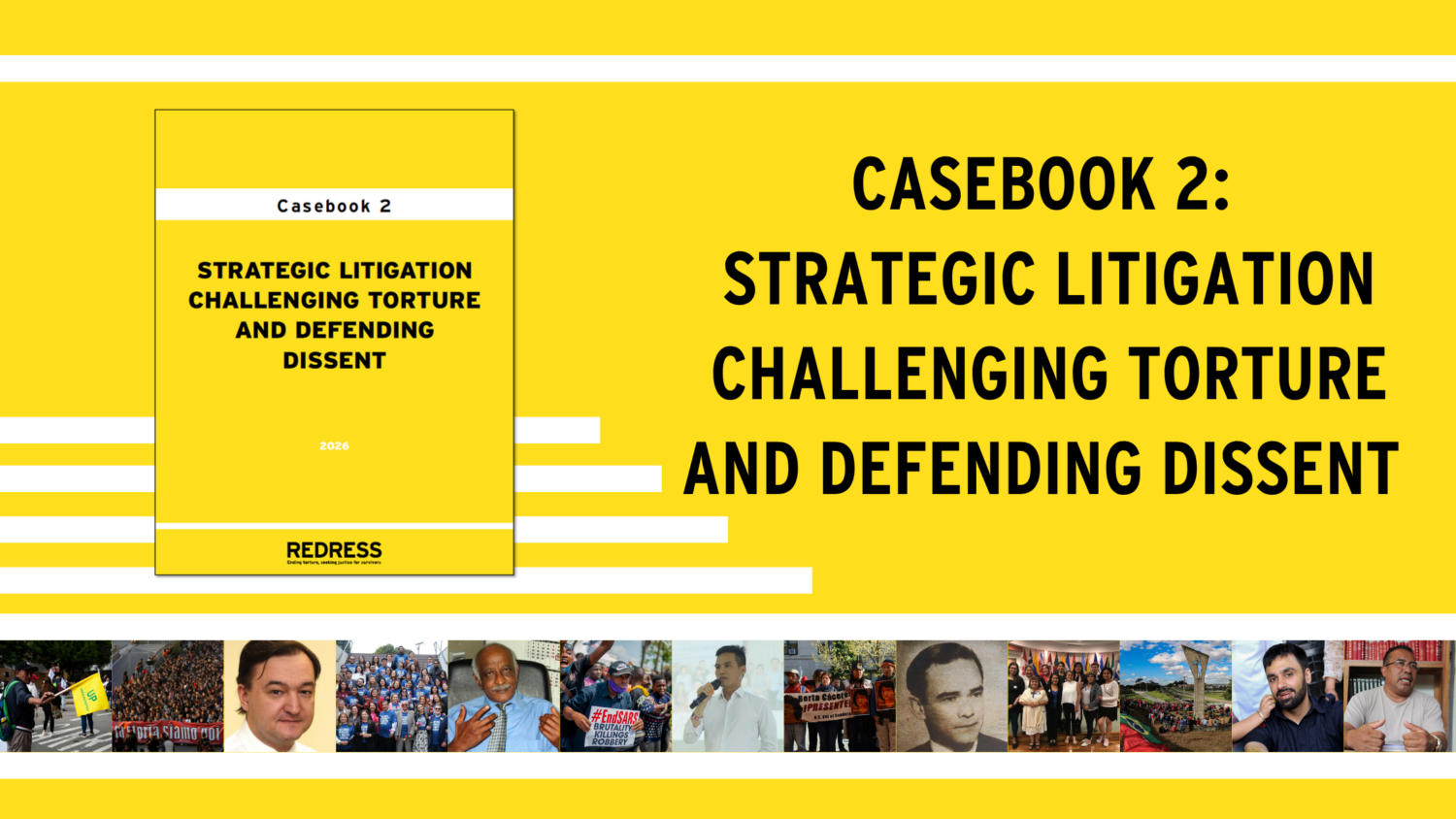
REDRESS’s Casebook Highlights Strategic Cases Challenging Torture and Defending Dissent
By Ana Cutts Dougherty, Legal Consultant, and Renata Politi, Senior Legal Advisor
Today, REDRESS is launching the second casebook in our series cataloguing leading strategic cases against torture. This new edition focuses on cases where torture and other forms of ill-treatment have been used to silence dissent — targeting protesters, journalists, human rights defenders, environmental human rights defenders, and political dissidents.
At a time marked by rising authoritarianism, shrinking civic space, and attacks on the rule of law, the role of those who speak out in defense of their fundamental rights and freedoms is more important than ever. They often carry out their work at great personal cost, facing violent repression. In recent decades, and to this day, there have been numerous cases of people in power using torture to intimidate critics and crush dissent.
This casebook tells the story of 26 such instances from across the globe, and the creative legal efforts pursued to challenge abuse and push back against repression. These cases were brought before different regional human rights mechanisms, as well as UN treaty bodies and Special Procedures. Each offers practical lessons on legal and advocacy strategies for achieving impact beyond the individual case and effecting broader societal change. While the legal outcomes of some of these cases may be widely known, the strategic approaches taken and the broader impact of the cases are less well known. Litigants rarely have the time or opportunity to systematically document how cases were litigated or why certain choices were made. Casebook 2, and our Casebook series as a whole, seek to address this gap.
Where possible, REDRESS has interviewed the lawyers and organisations behind the cases included in Casebook 2, shedding new light on their strategic features and impact. The casebook is structured around five themes: protesters; journalists; human rights defenders; Indigenous, land, and environmental human rights defenders; and political dissidents or those detained for exercising their rights.
For example, one case concerning protesters is the Tsaava and Others v. Georgia case, which advanced the European Court of Human Rights’ (ECtHR) approach on protest policing, particularly through its treatment of kinetic impact projectiles (commonly known as rubber bullets). By setting out minimum regulatory requirements and consolidating key principles on the use of less-lethal weapons, the Court strengthened European human rights standards. The ruling is likely to influence future litigation, case law, and potentially policy reforms across Council of Europe Member States. The case’s success was bolstered by strong civil society collaboration and detailed evidentiary documentation.
Another case featured in Casebook 2, Herzog v. Brazil, stands out as a landmark ruling for cases involving journalists. The Inter-American Court of Human Rights (IACtHR) firmly established that impunity for crimes against humanity constitutes a continuing human rights violation, regardless of how much time has passed. By holding that statutes of limitations cannot shield perpetrators of torture and murder committed under a dictatorship, the Court emphasised the importance of accountability. The judgment has had a tangible impact in Brazil, catalysing official acknowledgements of responsibility and reparation to victims’ families and contributing to broader debates on transitional justice and accountability in the region.
The case of Berta Cáceres, also featured in Casebook 2, highlights the threats faced by Indigenous, land, and environmental defenders. It demonstrates how State failures to act on repeated threats – and on precautionary measures issued by the Inter-American Commission on Human Rights (IACHR) – can enable powerful actors to use lethal violence to silence defenders. The case led to rare criminal convictions, an independent international investigation, and authoritative findings on corporate responsibility and State due diligence requirements, reinforcing protection for Indigenous human rights defenders and setting an important precedent for environmental justice in Latin America.
These are not just legal cases, but stories of courageous and inspiring survivors, family members, activists, and advocates. Some of the stories are of hard-won success and lasting impact, while others reflect perseverance to transform structural challenges that continue to this day.
The Casebooks are published alongside our Practice Notes, which offer practical guidance on key aspects of holistic strategic litigation against torture as well as examples drawn from REDRESS’s practice.
We hope this series serves as a practical and accessible resource for practitioners and activists alike, providing a toolbox of strategies to challenge abuse and defend dissent, fundamental freedoms, and rights around the globe.
In the coming weeks, we will publish additional blog posts featuring legal experts and practitioners reflecting on the strategies and the impact of the cases featured in Casebook 2.
The REDRESS Casebook series was produced with financial assistance from the European Union under the United Against Torture Consortium initiative. Its contents are the sole responsibility of REDRESS and do not necessarily reflect the views of the EU.