
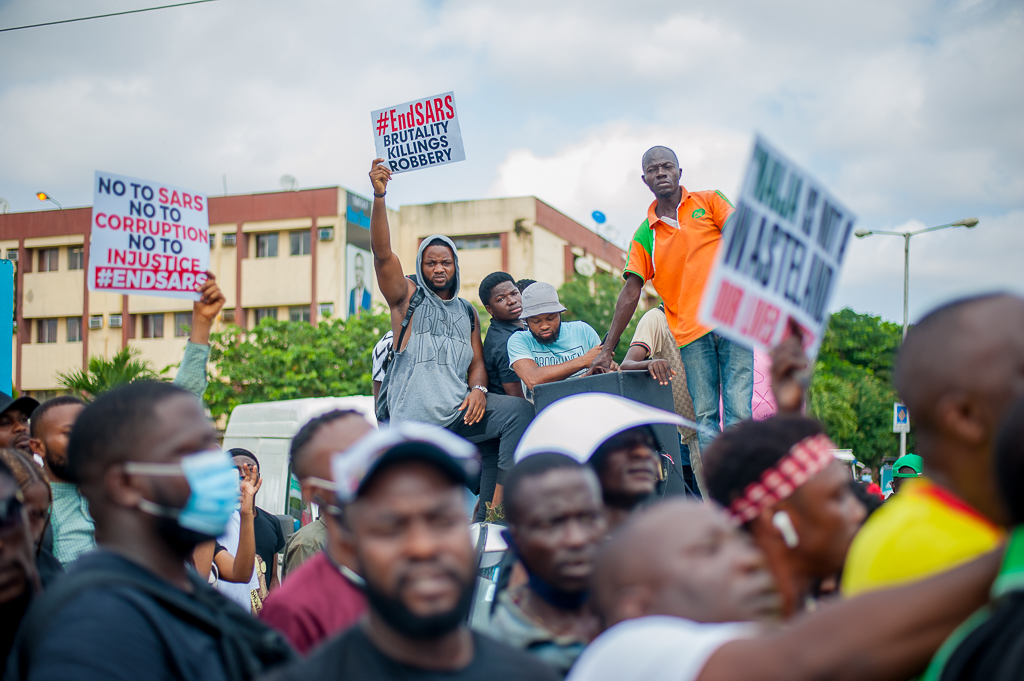
Lekki Toll Gate
On 10 July 2024, the Economic Community of West African States Court of Justice (ECOWAS Court) delivered a landmark judgment finding Nigeria responsible for serious human rights violations arising from the October 2020 Lekki Toll Gate massacre. While the decision marked an important step towards justice, the implementation of reparations and accountability has been slow and inconsistent. REDRESS and its partners continue to push for implementation and accountability, including urging States to impose targeted sanctions on alleged perpetrators and support enforcement of the Court’s decision.
STORY
In October 2020, nationwide protests erupted across Nigeria against the widespread harassment, abuse, and brutality carried out by the Special Anti-Robbery Squad (SARS), a unit of the Nigerian Police Force. On 20 October 2020, Nigerian security forces opened fire on peaceful, unarmed protesters gathered at the Lekki Toll Gate in Lagos. At least nine people were killed, and many others were seriously injured.
In 2021, a Judicial Panel of Inquiry established by the Lagos State Government found that the Nigerian military and police were responsible for the violations. However, several years later, its recommendations remain largely unimplemented, and victims have not received adequate justice or reparations.
ACTION FOR JUSTICE
The case before the ECOWAS Court was brought by three survivors of the massacre. They were supported by a coalition of Nigerian civil society organisations. The applicants alleged that Nigeria violated multiple international human rights instruments, including the UN Convention Against Torture, the African Charter on Human and Peoples’ Rights and the International Covenant on Civil and Political Rights. They claimed violations of the right to life, the prohibition of torture, and the rights to freedom of expression, assembly, and association.
In 2022, REDRESS urged the international community, including the UK Government, to impose coordinated targeted sanctions against the alleged perpetrators of the Lekki massacre. To date, the UK Government has yet to take effective action and sanction the perpetrators.
THE OUTCOMES
The ECOWAS Court found Nigeria unequivocally responsible for both substantive and procedural human rights violations, and ordered compensatory and declaratory relief to the applicants. The judgment represents a significant step forward in the ongoing fight for justice for the victims of Lekki.
The Court concluded that the applicants “established that they suffered physical, mental, emotional and psychological torture”. The state of fear, anxiety and psychological distress suffered by the applicants amounted to torture perpetrated through the disproportionate use of force and acts of the Nigerian security forces. Alongside the violation of the prohibition of torture, the Court also found that Nigeria had violated the right to life and freedom of expression, assembly, and association.
The Court highlighted the Nigerian authorities’ failure to properly investigate the violations and to provide effective remedies, despite prior findings by the Judicial Panel of Inquiry. It ordered the State to conduct a new investigation and awarded each applicant two million Nigerian Naira in compensation per violation, recognising the seriousness of the harm while noting the symbolic nature of reparations.
Two years after the judgment, implementation is still pending, and civil society organisations are advocating for its enforcement.
QUICK FACTS
- Case name: Lekki Toll Gate
- Jurisdiction: The Economic Community of West African States (ECOWAS) Court of Justice
- Date filed:15 December 2021
- Current status: Judgment obtained
- Legal representation: Bolaji Gabari, Mojirayo Ogunlana‑Nkanga
Photo by: Kaizenify CC 4.0