
Confronting Torture in the United Kingdom
By Rupert Skilbeck, Director, REDRESS
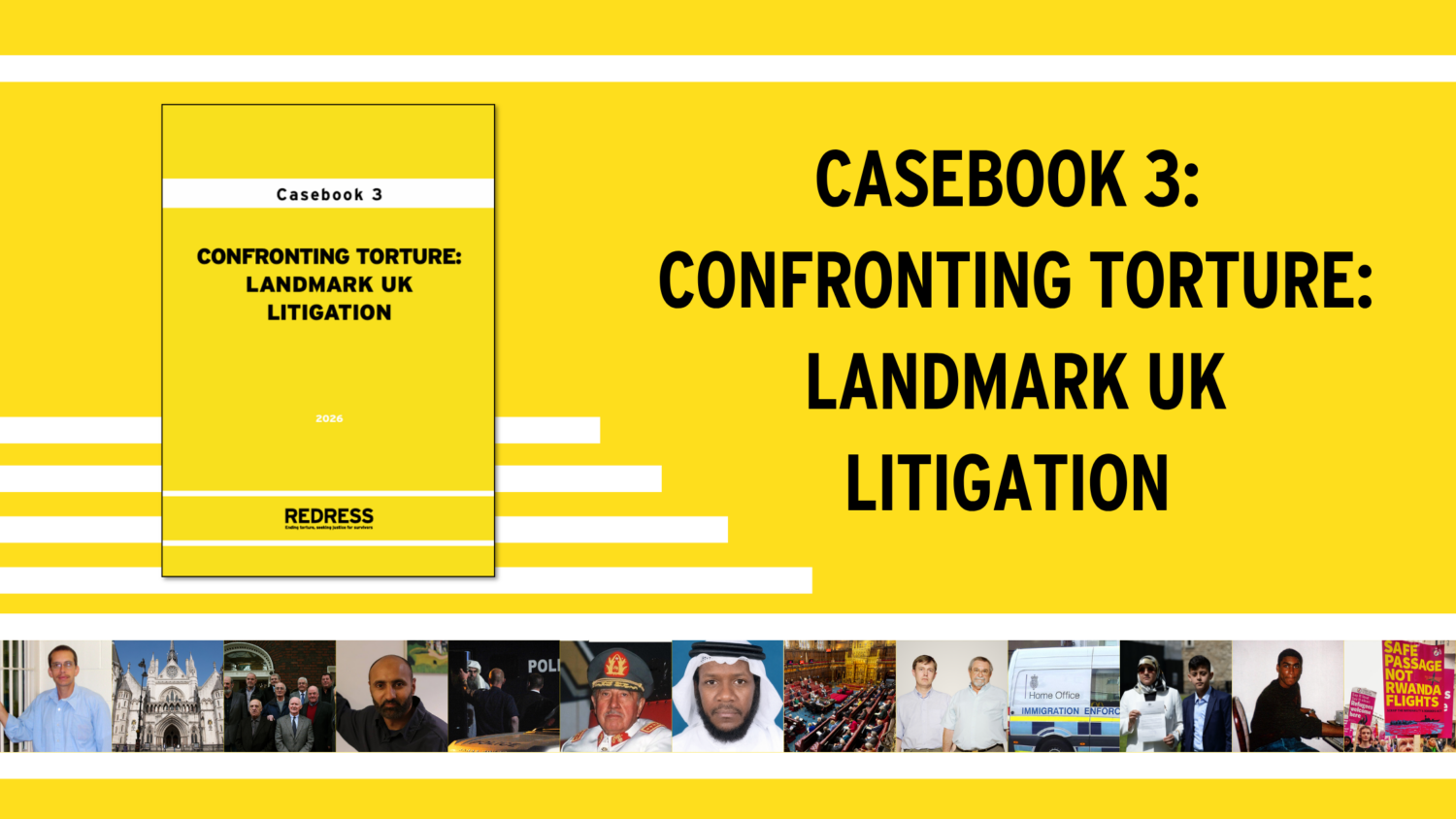
REDRESS has published a new casebook which tells the stories of some of the most significant legal cases challenging torture over the last decades. This latest edition focuses on 32 key decisions in the UK relating to torture, and demonstrates that even mature democracies need to have effective policies and an active strategy to counter torture.
The Casebook is part of REDRESS’s efforts to enhance understanding of the law against torture in the UK and elsewhere. The new publication forms part of a series of publications on key cases against torture, including Casebook 1 on Leading Strategic Litigation on Torture, and Casebook 2 on Strategic Litigation Challenging Torture and Defending Dissent. We are hugely grateful to the REDRESS staff, pro bono partners, and legal fellows whose expertise and commitment made the project possible.
The 20th century saw a practice of Britain using torture and cruel treatment against its opponents. As set out convincingly by Ian Cobain in his book Cruel Britannia: A Secret History of Torture, the British government used torture for decades, against German prisoners during the Second World War, during the closing years of the British Empire in Malaya, Aden, Cyprus, and Kenya, and during the conflict in Northern Ireland, where the infamous ‘five techniques’ for interrogation were finally exposed before the European Court of Human Rights.
As the Casebook sets out, the European Court of Human Rights and UK Courts have helped define the meaning of torture and ill-treatment. They have explored how the government has a duty to investigate torture, both in the UK and elsewhere. Judges have examined how to apply the absolute ban against torture or ill-treatment to the deportation or extradition of individuals where there is a risk of torture in a variety of situations, including the risk of the death penalty, destitution, cruel treatment such as whole life sentences and prolonged solitary confinement, and the particular risks that apply to political prisoners and to individuals suffering from medical conditions. UK complicity in torture by the CIA led to a series of cases that explored the responsibility of the security services for collusion in the US torture programme in the period after 9/11. The cases also explore how universal jurisdiction has been applied to prosecute torturers found in the UK.
There are a significant number of survivors of torture in the UK. There are no official figures, but based on the number of claims for asylum on the basis of persecution, the experience of medical groups providing specialist support to those who have faced trauma, and those statistics that are available, the number is likely to be in the hundreds of thousands. At the same time there are numerous perpetrators of torture present in the UK, with more than 100 people a year being denied refugee status on the basis that they had participated in atrocities.
The new Casebook also draws attention to the way that the UK government responds to torture, and exposes a lack of consistency in its approach to the protection of human rights. REDRESS has worked with the Survivor Advisory Group to draw attention to ten laws where UK legislation doesn’t uphold the absolute ban against torture, a position supported by UN Human Rights experts. REDRESS recently supported some legislative amendments that would have made it easier for the government to prosecute torturers in the UK, but the proposals were rejected. The UK will be reviewed by the UN Committee against Torture in 2027, which will be an opportunity for the government to respond to these failures.
More recently, the UK has supported the Chișinău Declaration of the Committee of Ministers of the Council of Europe. The Declaration was produced in response to calls to make it easier for countries in Europe to deport or extradite people, even where there is a risk of torture or ill-treatment on return. While REDRESS welcomes its re-affirmation of the absolute nature of the ban against both torture and ill-treatment, there are real concerns that the initiative will be used to undermine the absolute ban. The UK FCDO said that the Declaration will “support ambitious domestic efforts to restore order and control, including cracking down on individuals exploiting the system to avoid deportation”. Italian Prime Minister Georgia Meloni posted that “the Council of Europe gives green light to easier deportations” and that the Declaration was an acceptance that Europe should set up return schemes, such as her failed Albania return hub. Such statements indicate that governments want to go further than the text of the Declaration suggests.
The UK should avoid double standards in its approach to the ban on torture. This means not only calling for justice for international crimes when they happen abroad, but being prepared to face up to any atrocities by UK officials, properly investigate and prosecute when they take place, and to have an effective system for prosecutions under universal jurisdiction.
As these 32 cases show, the courts can address individual problems, but there needs to be a concerted and consistent approach to ensure that such failures do not persist. The government should use the opportunity of the 2027 United Nations review of the UK to conduct a comprehensive review of what laws and policies need to change, and to introduce a strategy against torture in response.
The REDRESS Casebook series was produced with financial assistance from the European Union under the United Against Torture Consortium initiative. Its contents are the sole responsibility of REDRESS and do not necessarily reflect the views of the EU.