
The Crackdown on Gen Z Protests in India: An Alarming Pattern of State Violence
By Edgar Kaiser, REDRESS visiting lawyer
तमिल में पढ़ें हिंदी में पढ़ें
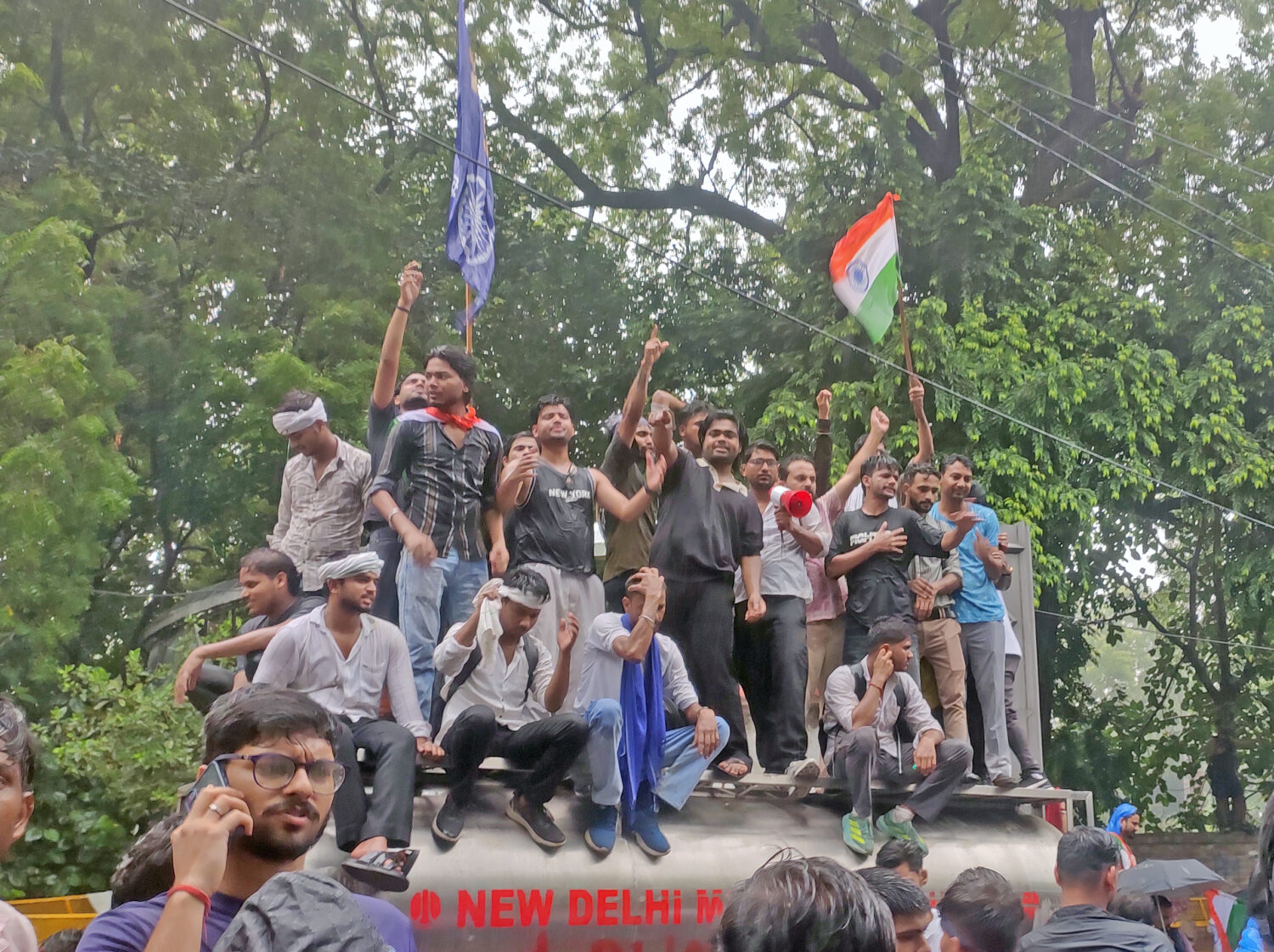
On 20 July 2026, India witnessed a landmark political moment when thousands of young people protested in the national capital and several other states, demanding reforms to the education system. Beyond its political significance, the protests also became crucial in exposing the state of civil liberties in the country. With tear gas, pellet guns, nail-studded lathis, stone-laden trucks and even rifles, the protest in Delhi and several other states were met by a violent State response. But none of this is new. It follows, almost point for point, the pattern documented by REDRESS in ‘Torture Normalised: State Violence in India.’
A familiar pattern
REDRESS’ report exposed the pattern of crackdowns on peaceful assembly in India, often involving torture or ill-treatment through the use of disproportionate force, including indiscriminate use of so-called ‘less-lethal weapons’. The report also identified how the Indian Government has been criminalising dissent by weaponising laws, in particular counter-terror laws, against anyone who challenges the Government. The report exposed a culture of impunity and systemic barriers to accountability for these violations.
Peaceful assembly met with brute force
Young people across India took to the streets on 6 June 2026, following massive online support for a political satire page called the Cockroach Janta Party, which was created as a response to the Chief Justice of India’s remark comparing the country’s youth to cockroaches.
A genuinely peaceful protest, characterised by the use of books, flowers, and the Constitution of India, continued for more than a month. Yet on 20 July 2026, the day the protesters announced their march towards the Parliament, they were met with pellet guns and tear gas deployed by authorities.
Even before violence broke out, the authorities used certain laws against protesters to restrict their right to peaceful assembly.
On the evening of 19 July, the night before the announced march, the Delhi Police issued a prohibitory order restricting the protesters from proceeding with the march. The Supreme Court had already commented that such an order should not be misused and only be exercised if material facts show a “likelihood of being able to prevent some harmful occurences” or a “disturbance to public tranquility”. Its use after 40 days of largely peaceful protest warrants scrutiny.
On 20 July, tear gas was fired into a seated crowd, nail-studded lathis were used against unarmed students, minors were arbitrarily detained, the internet was shut down, stone-laden trucks were parked at the protest site by the police, and at least 10 protesters were later found to have pellet injuries.
These actions raise serious concerns about the lawful use of force in protests. Authorities must appropriately police protests, adopt de-escalation measures should conflicts arise, and use force only as a last resort, and in strict accordance with its necessity and proportionality. Specifically, authorities should not use force simply to disperse crowds or deploy less-lethal weapons that may be indiscriminate.
The use of pellet guns is particularly concerning. Although they have been used by Indian security forces in Kashmir, their use has been strongly criticised by international human rights bodies. This is the first time that pellet guns have been reportedly used in the national capital, and there are concerns about its use being non-compliant with domestic procedures, such as the requirement to maintain a minimum distance of 500 feet. Firing pellet guns at closer range also carries the risk of penetrating organs.
Following the crackdown, many protesters suffered grievous pellet injuries, including one young protester who lost his eyesight. Journalists were attacked, women were reportedly sexually assaulted, and the stone-laden truck was later reported to have been parked by the police themselves.
In another Indian state, Bihar, police went as far as using an assault rifle to disperse protesters, a practice that breaches both domestic and international law.
The recent accounts of excessive use of force in protests in India raise serious concerns of violations of international law and standards, including obligations under the UN Convention against Torture, the UN Code of Conduct for Law Enforcement Officials (1977), the UN Basic Principles on the Use of Force and Firearms (1990) and the UN Guidelines on Less Lethal Weapons (2020), among others.
Near-zero accountability
What makes this pattern both persistent and deeply troubling is not just the violence alone, but the apparent absence of consequences for the perpetrators. When videos showing the violence were brought before the Supreme Court, the court reportedly said, “We don’t have time to watch videos”. The Delhi High Court also reportedly told lawyers, “Don’t drag the court into all this” when asked to examine the excessive use of force.
Accountability is essential to preventing human rights violations, and ensuring that they are properly investigated, perpetrators are held responsible, and survivors receive reparation. Yet in India, the institutions tasked with delivering accountability face significant structural weaknesses. The National Human Rights Commission (NHRC), a key body for addressing human rights violations, struggles with a substantial backlog, limited enforcement powers, and concerns about its institutional competence by the Global Alliance of National Human Rights Institutions (GANHRI). In its report, REDRESS raised concerns about the NHRC’s independence and its ability to effectively investigate human rights violations, echoing concerns expressed by the GANHRI and the Supreme Court of India. These shortcomings weaken oversight and contribute to a climate of impunity in which State violence persist and become normalised.
Nonetheless, in this case, the NHRC has taken cognisance of the reported brutality in the crackdown on Gen Z protests and ordered the Delhi Police to submit a report explaining the justification for the prohibitory order and the proportionality of the use of force.
The Supreme Court has taken up the issue and established an independent panel to investigate the police’s actions during the protest, thus, accountability for the officers involved and their superiors must be seen. While the police personnel involved in the firing of the rifle in Bihar have been suspended, justice requires ensuring all perpetrators are held accountable and effective reparations are awarded to survivors.
Torture Normalised called the Government of India to, among other measures:
- Ensure that international human rights law and standards on the use of force in protests are fully incorporated into domestic law and practice, including clear requirements of necessity and proportionality and strict limits on the use of lethal force.
- Repeal laws that grant immunity to public officials accused of human rights violations
- Ensure that the National Human Rights Commission’s (NHRC) recommendations are binding and adopt measures to ensure its independence and impartiality.
These are key recommendations to ensure the survival of constitutional rights in practice. The continuous pattern of using unlawful and disproportionate force in response to peaceful protests, as well as the impunity of those responsible must come to an end. Oversight mechanisms must be strengthened to inspire public confidence. The world’s largest democracy should treat one of the most basic democratic rights – the right to protest – not as a threat to be controlled, but as a right to be protected.
Photo by: Sumita Roy Dutta CC 2.0