Publications
REDRESS’ publications are also available in hard copy format. Please contact us for further information on [email protected].
The 2021 Universal Jurisdiction Annual Review (UJAR) highlights the impact of COVID-19 on prosecutions of torture, war crimes and other universal jurisdiction crimes across the world. It was researched and produced by TRIAL International with the contribution of REDRESS, the European Center for Constitutional and Human Rights, the International Federation for Human Rights, the Center for Justice and Accountability and Civitas Maxima. It benefited from the generous support of the Taiwan Foundation for Democracy, the Oak Foundation, the Foreign, Commonwealth & Development Office of the United Kingdom and the City of Geneva.
REDRESS and the People's Legal Aid Centre (PLACE) made this submission as part of the Universal Periodic Review (UPR) of Sudan. The submission focuses on progress made by Sudan's transitional government towards the effective prohibition of torture and other human rights abuses, as well as the additional steps needed to ensure their non-repetition and accountability for past violations,
The REDRESS 2025 Strategy sets out the priorities for the charity, with specific deliverables developed each year by the staff and the board for each of the programme areas. From 2021-2025 REDRESS will focus its efforts on the practical measures that are needed to deliver justice and reparation for survivors, and to ensure their wellbeing. We will target situations where we can have the most impact, particularly for torture relating to dissent and discrimination. We will significantly enhance our capacity to combat torture by building our pro bono networks and improving how we work with our global partners, while also developing the management and governance of REDRESS, and building our team.
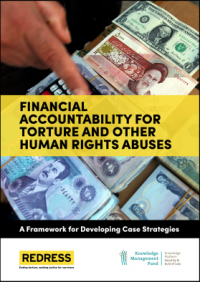
Perpetrators of torture and other serious human rights violations often profit financially from the abuses they carry out, whether directly (for example, through the proceeds of forced labour) or indirectly (for example, as part of a broader scheme of grand corruption). Yet, rarely are perpetrators deprived of their assets, nor do survivors receive reparations to repair adequately the harm they have suffered. With the support of the Knowledge Platform for Security & Rule of Law, we have identified a number of models that can promote financial accountability, through seizing or confiscating perpetrators’ illicit assets, and/or using those assets to pay reparations to their victims.
REDRESS’ Framework for Financial Accountability for Torture and Other Human Rights Abuses is designed to be used by NGOs and practitioners around the world that act on behalf of victims. It aims to serve as a tool to help identify, develop and evaluate potential case strategies for pursuing financial accountability for torture and other serious human rights abuses. The Framework identifies a range of legal and advocacy models that promote financial accountability, and challenge the financial impunity that some perpetrators enjoy. A core objective is to use perpetrators’ assets to fund reparations for their victims where appropriate mechanisms permit this.
As the European Union was expected to announce on 22 March 2021 sanctions against senior Chinese officials and entities linked to human rights violations in the Xinjiang Uyghur Autonomous Region of China, REDRESS wrote on 19 March 2021 to the UK Foreign Secretary Dominic Raab, calling for urgent action from the UK government in imposing similar sanctions. REDRESS’s new letter to the Foreign Secretary highlights the anticipated EU sanctions, and urges the UK to join its international allies in sanctioning Chinese officials.
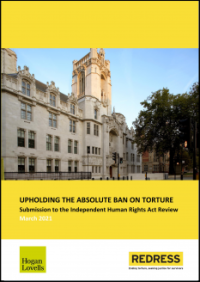
This submission was made in response to the call for evidence of the Joint Committee on Human Rights (a select committee of both the House of Commons and House of Lords in the UK Parliament) in its inquiry regarding the UK government’s Independent Human Rights Act Review. This submission has been prepared jointly by REDRESS and Hogan Lovells International and draws from REDRESS and Hogan Lovells’ lengthier submission in response to the call for evidence of the Review, which is available in its entirety here.
This submission was prepared jointly by REDRESS and Hogan Lovells in response to the call for evidence of the Independent Human Rights Act Review published 13 January 2021. The principal aim of this submission is to share an understanding of how the Human Rights Act 1998 has, through its existing framework, effectively implemented the absolute prohibition of torture and inhuman or degrading treatment or punishment, as set out in Article 3 of the European Convention on Human Rights. However, the Article 3 prohibition cannot properly be understood in isolation from the other ECHR rights, or from other human rights obligations accepted by the UK. Accordingly, where responses to questions in the call for evidence require, a holistic view is offered.