Publications
REDRESS’ publications are also available in hard copy format. Please contact us for further information on [email protected].
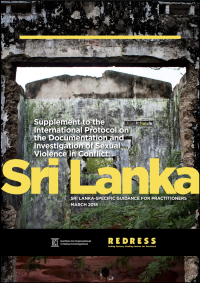
This guide, authored by REDRESS and the Institute for International Criminal Investigations (IICI), aims to assist practitioners gather evidence of conflict and atrocity-related sexual violence in Sri Lanka. It complements the second edition of the International Protocol on the Documentation and Investigation of Sexual Violence in Conflict which was published in March 2017 by the UK Foreign and Commonwealth Office (FCO). This guide is intended for practitioners who work in and on Sri Lanka.
It looks at the specific context for such violence in Sri Lanka, the forms it commonly takes and impacts it may have, available legal avenues for justice at the domestic and international levels, specific evidential and procedural requirements and practical issues that may arise when documenting sexual violence crimes in the country. All users are free to update, correct and adapt the Supplement as needed. IICI has also arranged a Tamil translation of the International Protocol (second edition), also linked here.

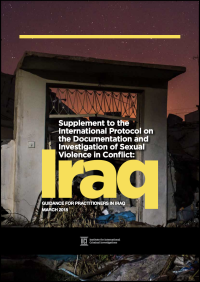
Sexual violence is a prominent and well-publicised aspect of the ethnic cleansing committed in Northern Iraq by Da’esh since 2014, including the creation of a complex system of slavery that includes rape, forced marriage and sexual violence. However, as elsewhere, conflict and atrocity-related sexual violence is not a new phenomenon in Iraq. This guide, authored by the Institute for International Criminal Investigations (IICI), aims to assist practitioners gather evidence of these forms of violence in Iraq, helping to overcome some of the key barriers to tackling impunity for these crimes.
It complements the second edition of the International Protocol on the Documentation and Investigation of Sexual Violence in Conflict, which was published in March 2017 by the UK Foreign and Commonwealth Office (FCO). The Supplement is specifically intended for practitioners who work in and on Iraq. All users are free to update, correct and adapt the Supplement as needed. REDRESS and IICI are grateful for the support to the project of the FCO.

In their annual report Make way for justice #4, REDRESS and its partners TRIAL International, FIDH, ECCHR, and FIBGAR illustrate the international momentum towards accountability through 58 cases, involving 126 suspects.
The report, 'Beyond Discretion: The Protection of British Nationals Abroad,' reviews the experiences of several UK nationals with regards to the provision of consular assistance and diplomatic protection. In the UK, both consular assistance and diplomatic protection are not enshrined in UK law but are regulated instead as a matter of policy and thus are actions that are taken at the discretion of the UK government. The report calls for the introduction of a right to consular assistance to be part of UK law and an obligation for the UK government to exercise diplomatic protection where UK nationals, including dual nationals, have suffered or face a risk of serious human rights violations while abroad, when requested.
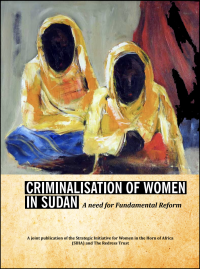
The report, ‘Criminalisation of Women in Sudan: A Need for Fundamental Reform’, shows how public order laws, designed to protect morality, continue to disproportionately target women, who can face long spells in jail and flogging for infractions such as wearing ‘trousers’. Focusing on Khartoum state, the reports describes the experiences of some of the women most affected by the application of these laws, including alcohol brewers and sellers, human rights defenders, female students and migrant women. The report was written by the Strategic Initiative for Women in the Horn of Africa (SIHA) and REDRESS.
This submission, authored by the Victims' Rights Working Group (VRWG), facilitated by REDRESS, makes several recommendations to the International Criminal Court (ICC), the ICC Trust Fund for Victims, and to the States Parties of the Court, in order to establish a more coherent and holistic approach to the protection and realisation of victims’ rights. In particular, the VRWG suggests a revision of the ICC’s 2012 Victim Strategy, the creation of a separate legal aid system for victims, and the clarification of the procedures that facilitate effective implementation of the Court’s reparation system.
This letter, authored by REDRESS and Amnesty International UK, urged the UK Ambassador to Iran, Nicholas Hopton, to press for the release of two dual nationals arbitrarily detained in Iran, ahead of the 4th Europe-Iran Forum business conference series that took place in 2017 in Zurich at which he was due to speak.
Les parties civiles devant la Cour Pénale Spéciale (« CPS ») sont victimes de violations graves du droit international. Par conséquent, les réparations symboliques ou morales, à elles seules, ne sont pas suffisantes pour remédier au préjudice subi. Le Règlement de procédure et preuve («RPP ») risquerait d’être en contradiction avec le CPP centrafricain et en violation des obligations internationales de la République Centrafricaine s'il devait restreindre la portée des réparations qui seraient appropriées pour réparer le préjudice subis par les parties civiles. Il est primordial que le RPP fournisse un cadre juridique pour que les victimes obtiennent réparation et que ce cadre soit conforme au droit international et réponde aux droits et attentes des victimes.