Publications
REDRESS’ publications are also available in hard copy format. Please contact us for further information on [email protected].
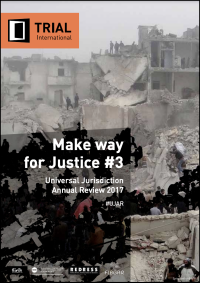
This report, co-authored by REDRESS, TRIAL International, the International Federation for Human Rights (FIDH), the European Centre for Constitutional and Human Rights (ECCHR), and The International Foundation Baltasar Garzón (FIBGAR), looks back on the unprecedented momentum of Universal Jurisdiction in 2016. In 47 cases across 13 States, States implemented Universal Jurisdiction in order to prosecute criminals regardless of their nationality or where the crime was committed, proving the doctrine to be a significant practical tool against impunity in Syria, Rwanda, Nepal, Guatemala, Iraq, and elsewhere. REDRESS calls upon domestic jurisdictions around the globe to seize this growing opportunity to bring justice to the perpetrators of crimes against humanity, war crimes, and torture.
REDRESS’ submission to the United Nations Committee Against Torture concerns Bahrain’s consistent failure to investigate the arbitrary detention, torture, and ill-treatment of Member of Parliament Jawad Fairooz Ghuloom Fairooz. Jawad Fairooz currently lives in the UK, where he obtained asylum following his prosecution in Bahrain for charges contravening his freedom of expression, peaceful assembly, and association. He was unilaterally stripped of his Bahraini citizenship. Since 2013, REDRESS has continued to submit detailed letters to the UN concerning Bahrain’s violation of state responsibility in addressing his alleged torture. The Bahraini government must produce evidence to explain his arrest and the brutal detention procedures to which he was subjected.
Depuis la révolution du 17 décembre 2010 – 14 janvier 2011 et la chute de l’ancien président de la Tunisie Ben Ali, la Tunisie doit faire face au défi que représente la transition démocratique et l’édification d’un Etat de droit respectueux des droits humains. Ce rapport essaiera de dresser un état des lieux des garanties existantes en matière de prévention de la torture, aussi bien sous l’ancien régime qu’après la révolution. Le commentaire se base sur des délibérations pendant une table ronde qui a été tenue à Tunis en novembre 2016, organisée par REDRESS en collaboration avec DIGNITY et le Ministère tunisien de la relation avec les instances constitutionnelles et la société civile des droits de l’Homme.
This report, ‘Assessment of reforms and future prospects for the eradication of torture in Tunisia’, summarises the roundtable deliberations held at Tunis in November 2016 concerning practical steps towards the eradication of torture in Tunisia. Relying on interviews with national experts working on the prevention of torture, this document contains a review of the existing legal frameworks and domestic mechanisms that enshrine the prohibition of torture.
Authored in collaboration with Barbara Maigari (JI Fellow) Partners West Africa-Nigeria and Legal Resources Consortium, this Commentary considers the challenges and opportunities present in the adoption of a comprehensive anti-torture bill in Nigeria, and offers concrete recommendations for its introduction to relevant stakeholders. Relying on interviews with national experts, a comprehensive literature review, and several consultative meetings, this report briefly outlines the practice of torture and ill-treatment in the Nigeria, and identifies shortcomings in the existing legal framework that need to be addressed in accordance with the country’s international obligations.
This report summarises the proceedings of the stakeholder roundtable organised by the Human Rights Center at the University of California, the International Center for Transitional Justice (ICTJ) and REDRESS, to assess how to best incorporate techniques of victim participation at the ICC and other comparative jurisdictions into the workings of Uganda's International Crimes Division (ICD). The ICD is the first domestic judicial body in Uganda to try international crimes, in particular war crimes, crimes against humanity, and genocide. Participants were made up of relevant actors of the ICD, experts on the implementation of victims’ rights at the ICC, and those working on the domestic implementation of victims’ rights in the United States and Kenya.
In a statement during an event to commemorate the 25th anniversary of the UN Working Group on Arbitrary Detention (WGAD) on 28 November 2016, REDRESS Director Carla Ferstman reiterated the crucial role of the WGAD several REDRESS' cases involving arbitrary detention, including the cases of Zeinab Jalalian, Andargachew "Andy" Tsege and Nazanin Zaghari-Ratcliffe.
With the International Criminal Court (ICC) conducting its first reparations proceedings in four separate cases, the Victims' Rights Working Group's participation in the 15th session of the Assembly of States Parties (ASP) focused on how to best give full effect to the rights of victims as enshrined in the Rome Statute, in particular, their right to participation, representation and reparation. This paper by the Victims' Rights Working Group (VRWG), a network of national and international experts that advocates for victims' rights before the ICC, informally facilitated by REDRESS, provides recommendations to States Parties on how to improve the ability of victims to fully exercise their rights.