
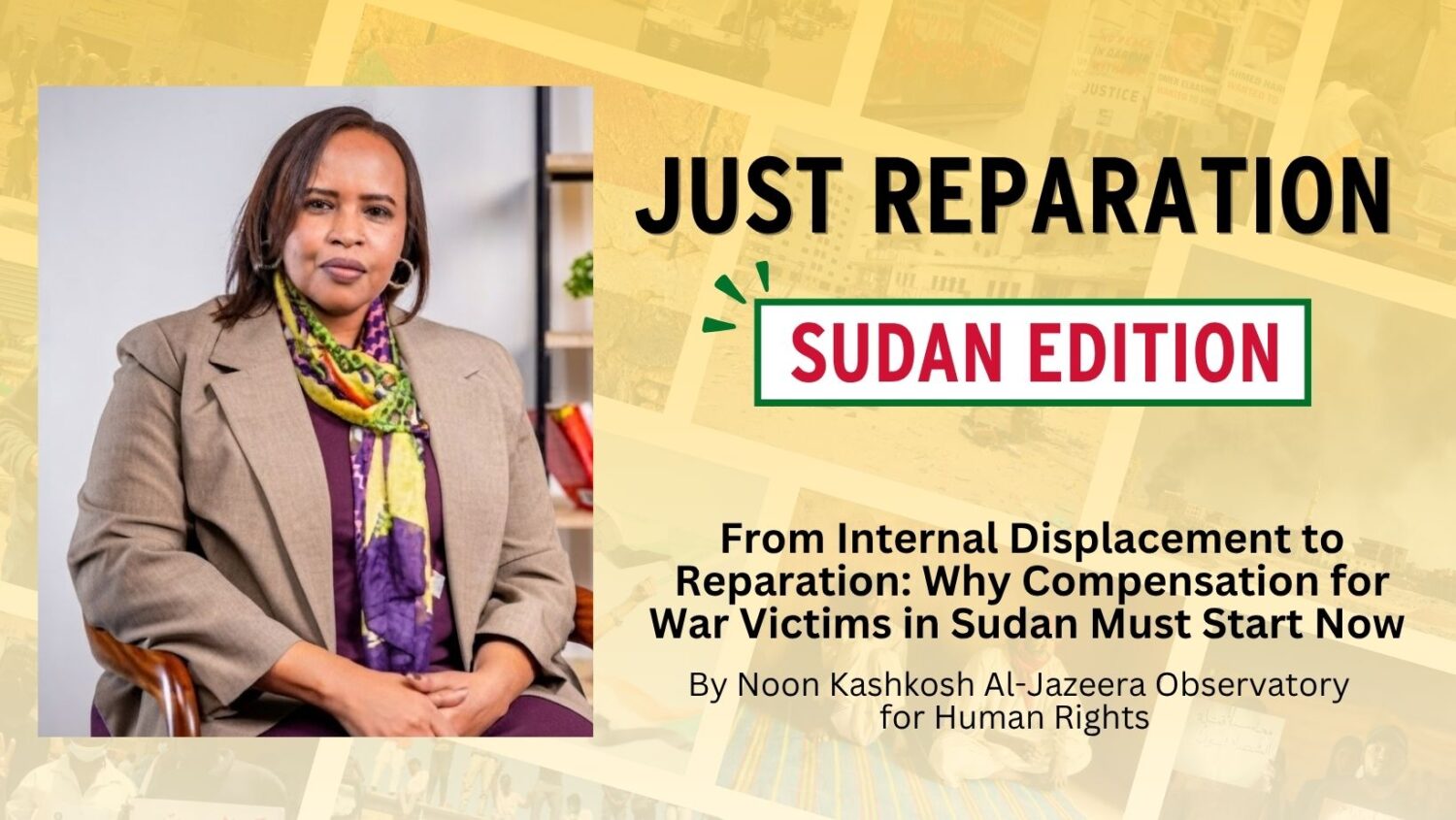
From Internal Displacement to Reparation: Why Compensation for War Victims in Sudan Must Start Now
By Noon Kashkosh Al-Jazeera Observatory for Human Rights
Lire en français Leer en español Читати українською
This article is part of the Sudan edition of our Just Reparation newsletter, which brings together perspectives from practitioners, advocates, and organisations working alongside survivors of torture and other serious human rights violations in Sudan. This special edition explores ongoing discussions, initiatives, and pathways towards securing reparation for victims of the conflict in Sudan.
Since the outbreak of the war in Sudan on 15 April 2023, forced displacement has become one of the most widespread and persistent aspects of the conflict. According to the International Organization for Migration (IOM), approximately 6,428,682 people have been internally displaced (IDPs) since 2023. Displacement has not been merely a by-product of the fighting; it has occurred within the context of grave violations against civilians, including extrajudicial killings, attacks on residential areas, arbitrary arrest, enforced disappearance, torture, looting and destruction of homes, farms, and property, conflict-related sexual violence, and forced displacement. The blockade and the cutting off or destruction of water, food, and health services have also exposed civilians to additional risks. When the elements and context of these acts are established, some may constitute war crimes or crimes against humanity. This blog post aims to highlight the urgent need for participatory reparation programmes that provide meaningful relief to displaced populations while ensuring robust accountability mechanisms.
Cycle of loss and re-displacement
Displacement should not be measured solely by the number of people who left their homes, but also by the extent of the harm they suffered and the losses they incurred as a result. In the states of Gezira, Sennar, and Blue Nile, population movements over more than three years reveal a pattern of repeated displacement that has transformed the lives of thousands of families into a cycle of loss and re-displacement.
In Gezira State, the Gezira Human Rights Monitor documented the displacement of residents from 268 villages. This means more than just the loss of housing; entire communities have lost their land, farms, possessions, sources of income, and social networks. In many cases, the displacement was not a single journey: Khartoum, then Gezira, then Sennar, then Blue Nile.
The city of Al-Hilaliya in Gezira State represents one of the most prominent cases requiring documentation within eventual reparation programs. Civilians were subjected to attacks by the RSF after Abu Aqla Kikel defected and aligned with the Sudanese Armed Forces. The city was also besieged, resulting in civilian casualties, mass deaths due to food poisoning, deteriorating health conditions, and a lack of food, water, medical care, and thousands of displaced people. According to a local census, 800 civilians lost their lives, including 298 men, 395 women, and 107 children. Of these, 485 died within Al-Hilaliya.
Despite the magnitude of these losses, the families of the victims and survivors have not yet received any form of reparation or urgent support to help them cope with the humanitarian, economic, and health consequences of these violations.
As for Sennar, it became a major displacement hub in 2024 following the escalation of military operations and the fall of Sinja. Blue Nile State received large numbers of people fleeing the fighting, some of whom had previously been displaced from Khartoum or Gezira. . In Blue Nile State, Damazin and its surrounding areas became a major host centre. According to the latest available data, the number of IDPs in the region reached approximately 376,373. The IOM’s Displacement Tracking Mechanism recorded 59,742 new displacements within the region between January and May 2026, representing approximately 11,956 families. These figures should not be combined, as they measure two different indicators: the number of IDPs already present and the number of new displacements within a specific period. The year 2026 witnessed a further escalation, particularly in Kurmuk and Bau. The Qaysan incident led to further waves of displacement. Field information gathered by the Observatory up to 18 August 2026 indicates the continued displacement of residents from areas including Bara, Khartoum Balil, and Amurat. Registration and census operations are still ongoing, demonstrating that displacement figures are not static but rather reflect a dynamic crisis that evolves as the conflict continues.
However, the most crucial question for the victims is not simply where they are living now, but what they have lost and how this harm can be redressed.
This highlights the need to move beyond purely humanitarian responses to consider temporary redress. Cash assistance for families who have lost their homes and livelihoods, support for restoring livelihoods, housing rehabilitation, legal aid in reclaiming land and property, and psychosocial care for victims are not merely forms of social assistance; they can be urgent steps toward addressing the harm caused by grave violations.
Documenting violations should be one of the first steps towards achieving justice and reparation, whether reparations are administrative or follow court rulings. Documentation helps preserve evidence; identify victims and the harm they suffered, contribute to truth-telling processes, and can form the basis for future justice, accountability, and reparation processes.
Reparation is not a substitute for justice, nor does reparation replace accountability. Assistance must be designed so as not to preclude victims’ future rights to full compensation, restitution of property, truth, and accountability.
Participation of victims in designing reparation programmes should be an essential part of this process. Involving victims in identifying their needs and priorities helps in designing programmes that are more relevant to their lived reality.
Reparation cannot be postponed until after the end of the war or the completion of the transitional justice process. Sudan needs to stop the war, but it also needs a path that recognises those who paid the price. From here, thinking about reparation must begin now: not as a post-peace phase, but as part of building a more just peace that restores the rights and dignity of the victims and puts the human being at the centre of the recovery and state-building process.
Read other articles in this series:
- The Potential Role of an International Accountability Mechanism for Sudan
- Justice and Reparation Cannot Wait for the War to End
- From Documentation to Reparation: Why Sudan Needs a Victims’ Registry
- Accountability, Victims’ Rights and Reparation in Sudan: A Country in Crisis
- Born as a Result: An Open Question for the Reparation Phase
- Galvanising the African Union’s Role on Sudan
This edition of the Just Reparation newsletter was co-funded by the European Union. Its contents are the sole responsibility of the organisations that produced this publication and do not necessarily reflect the views of the European Union.
