
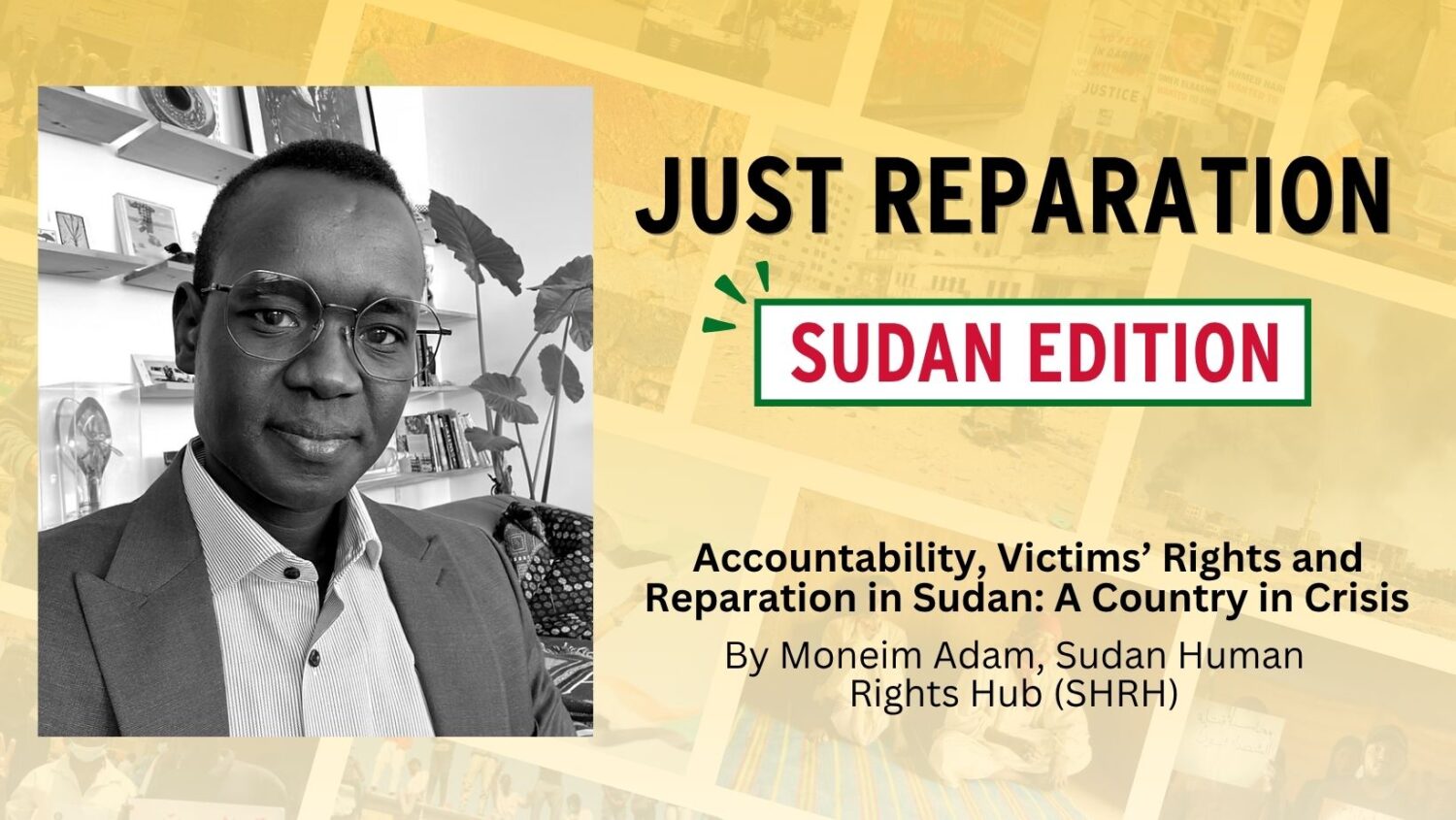
Accountability, Victims’ Rights and Reparation in Sudan: A Country in Crisis
By Moneim Adam, Sudan Human Rights Hub (SHRH)
Lire en français Leer en español Читати українською
This article is part of the Sudan edition of our Just Reparation newsletter, which brings together perspectives from practitioners, advocates, and organisations working alongside survivors of torture and other serious human rights violations in Sudan. This special edition explores ongoing discussions, initiatives, and pathways towards securing reparation for victims of the conflict in Sudan.
The ICC’s conviction of Ali Kushayb marks a historic milestone for victims of atrocities committed in Darfur. Yet, as Moneim Adam argues, the judgment also highlights the immense challenges of delivering meaningful reparation to communities still facing violence, displacement, and insecurity.
The ICC recently delivered its first guilty verdict on the horrendous crimes committed in Darfur almost two decades ago, ending absolute impunity. The case derives from the first prosecution directly related to the Janjaweed militia crimes and is the only verdict delivered for international crimes done in the past in Sudan. The verdict is especially important because of the renewed conflict between the SAF and the RSF an offshoot of the Janjaweed, that has been raging in Sudan for over three years and has led to the country becoming the world’s largest humanitarian crisis.
Ali Kushayb was sentenced to 20 years in prison. This is less than the maximum sentence of 30 years that the Rome Statute provides for, or life imprisonment, which is applicable in some cases. The charges respond to crimes committed from August 2003 to April 2004 and include 27 counts of war crimes and crimes against humanity in Darfur. The court found that Kushayb’s heinous acts had ravaged cities in West Darfur and targeted non-Arab civilians. The verdict established his close collaboration with the Sudanese authorities, demonstrating how local militias turned into instruments of state repression.
The verdict has proven that there is hope, and that impunity in Sudan will not be the eternal option.
The mass atrocities and the Long Road to Reparations
During the ICC proceedings, we were supporting survivors, their family members, and community leaders to visit and watch the trial in The Hague. As the court session was about to begin, the curtains were opened to let the audience view the courtroom. A Fur tribe leader fainted immediately once he saw Kushayb in the courtroom and was sent to the hospital; when he recovered, he said he could not bear to look at Kushayb since it had reminded him of terrible times. The last time he saw him it was when Kushayb came to their family near Mukgar and kidnapped his brother in 2004. To date, they remain unaware of his fate.
In Darfur, where people have grown up hearing promises of accountability, they have welcomed this conviction. The decision is a message that justice is achievable, even if late or in part. Whether in person or via satellite internet, people from refugee or IDPs camps in Darfur, survivors followed the courtroom proceedings. Furthermore, they are advocating for the conviction of the remaining fugitives, including Omar al-Bashir. Despite the huge importance of this judgement, this decision shows the difficulty of justice and reparation of this level of magnitude.
Reparations Beyond the Courtroom
After the conviction, the ICC has a big challenge: the adoption of a reparations order to provide redress for around 140,000 individuals in a context of ongoing atrocities. After hearing proposals from parties to the case and third-party interveners, the Court will decide on the scope and extent of reparations, and the Court’s Trust Fund for Victims (TFV) will implement the order.
Significant obstacles remain regarding the implementation of the expected ICC’s reparation order due to complex structural challenges. Here are a few points driven by the community’s calls for justice. Implementation of reparations is going to face huge challenges, including:
- Sudan is not a State Party to the Rome Statute and lacks the willingness to cooperate with the ICC.
- The ongoing conflict fosters a hostile environment that severely hinders collaboration in executing the court’s decisions.
To be truly meaningful, reparation must address several critical and complex components:
- A formal acknowledgement and public apology for the gravity of the crimes perpetrated against these communities and the assurance that survivors and relatives have the right to commemorate their loved ones without barriers or further reprisals.
- The psychological and social aid needed to reconstruct survivors’ lives, a legal requirement, not an act of beneficence, including educational facilities, psychosocial support, and health care services for the populations.
- The ban of institutional discrimination, enforcing protective laws for the communities, and recognising them as a protected group that deserves targeted equity programs.
- Monetary compensation
- Reparations should include a clear path for communities to one day reclaim their ancestral homelands, such as a symbolic declaration by the Court. The clearest expression of restitutio in integrum is the recovery of one’s land and territory, as it aims to restore victims to the situation that existed before the violation.
- Given the ongoing insecurity in Darfur, any discussion of reparations must be accompanied by credible and enforceable guarantees of safety. Without protection from further attacks by military or affiliated militia forces, financial compensation risks becoming merely symbolic. Compensation without protection is not meaningful reparation.
The above-mentioned components are both urgent and essential. However, given the limited scope of the reparations order that the ICC is expected to issue against Kushayb, some of these needs cannot be adequately addressed through a court decision alone. A comprehensive reparation programme is therefore also required, with clear implementation mechanisms and avenues for delivery. This should include an acknowledgement of responsibility by the Government of Sudan, sustained international cooperation, and the adoption of effective measures to provide redress to victims and affected communities.
This verdict is considered a great achievement but will face serious challenges in implementing any reparation due to security problems and the massive displacement of communities within the country and beyond. The international community should support the ICC and also create a special tribunal to help bring an end to impunity, especially in relation to the current conflict.
Read other articles in this series:
- The Potential Role of an International Accountability Mechanism for Sudan
- Justice and Reparation Cannot Wait for the War to End
- From Internal Displacement to Reparation: Why Compensation for War Victims in Sudan Must Start Now
- From Documentation to Reparation: Why Sudan Needs a Victims’ Registry
- Born as a Result: An Open Question for the Reparation Phase
- Galvanising the African Union’s Role on Sudan
This edition of the Just Reparation newsletter was co-funded by the European Union. Its contents are the sole responsibility of the organisations that produced this publication and do not necessarily reflect the views of the European Union.
