
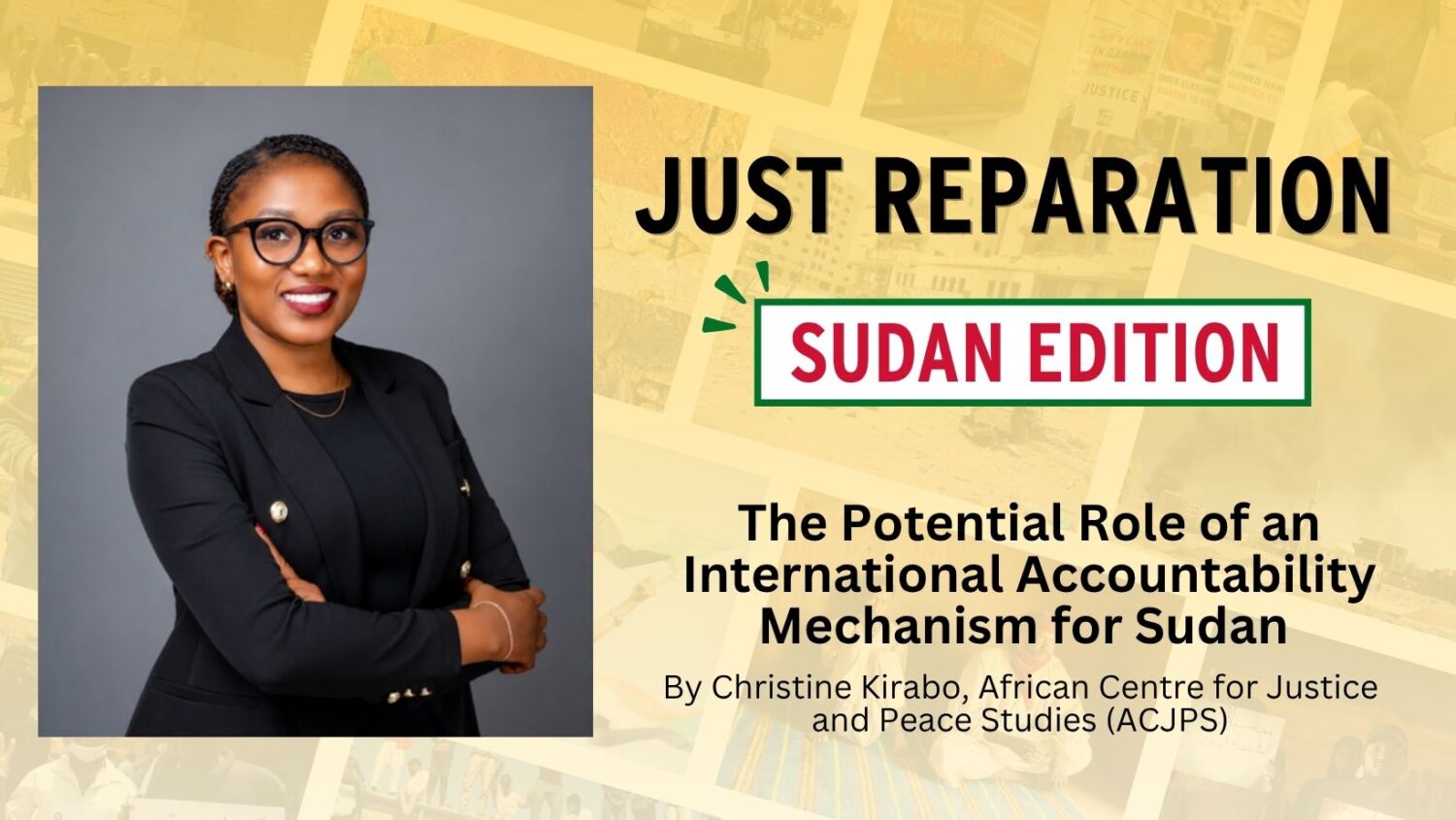
The Potential Role of an International Accountability Mechanism for Sudan
By Christine Kirabo, African Centre for Justice and Peace Studies (ACJPS)
Lire en français Leer en español Читати українською
This article is part of the Sudan edition of our Just Reparation newsletter, which brings together perspectives from practitioners, advocates, and organisations working alongside survivors of torture and other serious human rights violations in Sudan. This special edition explores ongoing discussions, initiatives, and pathways towards securing reparation for victims of the conflict in Sudan.
The ACJPS has documented the case of Alfatih Ali, a humanitarian worker arrested by the RSF in Nyala, South Darfur, on 31 August 2024 while carrying out humanitarian assistance. He was never charged with a criminal offence. His case is one of the hundreds documented by the ACJPS since the war began, and they have taught me something about where accountability discussions in Sudan tend to go wrong. Families rarely begin by asking for prosecutions or judgments. They want to know where their loved ones are, what happened to them, and whether the violations they suffered will be officially acknowledged. For many victims and survivors, justice and reparative measures come only after these more immediate needs are addressed. Any accountability mechanism for Sudan must be designed with that order of priorities in mind.
It is worth being honest about how thin the current architecture is. The ICC jurisdiction over Sudan comes entirely from a 2005 Security Council referral limited to the situation in Darfur, and even within that narrow scope, only one person has ever been convicted. Ali Kushayb was found guilty in October 2025 and sentenced to twenty years for 27 counts of crimes against humanity and war crimes committed in 2003 and 2004. That is a significant milestone after two decades, and the reparations proceedings now opening in that case, with more than 1,500 victims already recognised, matter enormously to the Fur communities who have waited that long. But it is a case about the “first Darfur war”. Nobody has yet been held to account, anywhere, for a single crime committed since the current conflict began in April 2023, and, unless there is a sufficient connection to Darfur, the ICC has no mandate at all over what has happened in Khartoum, Kordofan, Gezira or the other regions consumed by this war.
The UN’s Independent International Fact Finding Mission has partly filled that gap since 2023, and its reporting has been unflinching, including its February 2026 finding that the RSF’s campaign in El Fasher bore the hallmarks of genocide. But while the Mission can document and preserve evidence, it cannot prosecute anyone or order compensation. The African Commission of Human and Peoples Rights’ own Fact Finding Mission has been doing parallel work. In May this year the two bodies issued a joint declaration calling for an African-led mechanism, operating alongside the ICC, to actually investigate these cases. It is a welcome signal of political appetite. It is also, as critics have already pointed out, still a paragraph of intent rather than an institution, without a clear jurisdictional theory, a budget, or a route to enforcement in a country whose own courts have effectively stopped functioning.
That is the gap a genuine international or hybrid mechanism needs to close: something with a mandate that covers the country and the current war, not just Darfur and 2003, and with the power to try cases rather than only document them. Just as important is what such a mechanism would need to get right from the outset. The ICC’s experience is instructive here mostly as a warning. As per the Rome Statute, reparation is a phase that begins after conviction, which in the Kushayb case means victims are only now, more than two decades on, submitting arguments on what they are owed.
A mechanism built for Sudan’s current conflict should urgently start regardless any conviction. Victim participation, evidence of harm, and a functioning reparations arm belong in the design from day one.
We need to learn from past implementation failures and comprehensively address victims’ right to reparation. The Juba Peace Agreement already contains a Darfur compensation and reparation protocol, addressing return of looted property and community level redress, that has simply never been implemented. Any new mechanism should be asking how it connects to that unfinished commitment, rather than treating reparation as a purely international invention landing on Sudan from outside.
None of this will work unless the basics are prioritised and resourced accordingly: investigators who can reach the places where crimes happened, protection for the witnesses and survivors who speak to them, and preservation of evidence that is currently scattered across two FFMs, the ICC’s Office of the Prosecutor, ACJPS’ case files, and communities documenting their own losses with almost no support. I have seen how much evidence simply disappears when nobody has the mandate or the resources to hold onto it. A mechanism that arrives after that evidence has degraded will have very little left to work with, no matter how well designed it is on paper.
The relationship between accountability and reparation is not sequential, one following the other once the first is achieved. Alfatih Ali’s case is still open. So are hundreds like it. For the people behind those files, accountability and reparation are the same demand, differently phrased: tell us what happened, say who did it, and repair what can still be repaired. An international mechanism for Sudan will only be worth building if it treats that as its starting brief, not as an outcome to be worked out later.
Read other articles in this series:
- Justice and Reparation Cannot Wait for the War to End
- From Internal Displacement to Reparation: Why Compensation for War Victims in Sudan Must Start Now
- From Documentation to Reparation: Why Sudan Needs a Victims’ Registry
- Accountability, Victims’ Rights and Reparation in Sudan: A Country in Crisis
- Born as a Result: An Open Question for the Reparation Phase
- Galvanising the African Union’s Role on Sudan
This edition of the Just Reparation newsletter was co-funded by the European Union. Its contents are the sole responsibility of the organisations that produced this publication and do not necessarily reflect the views of the European Union.
