
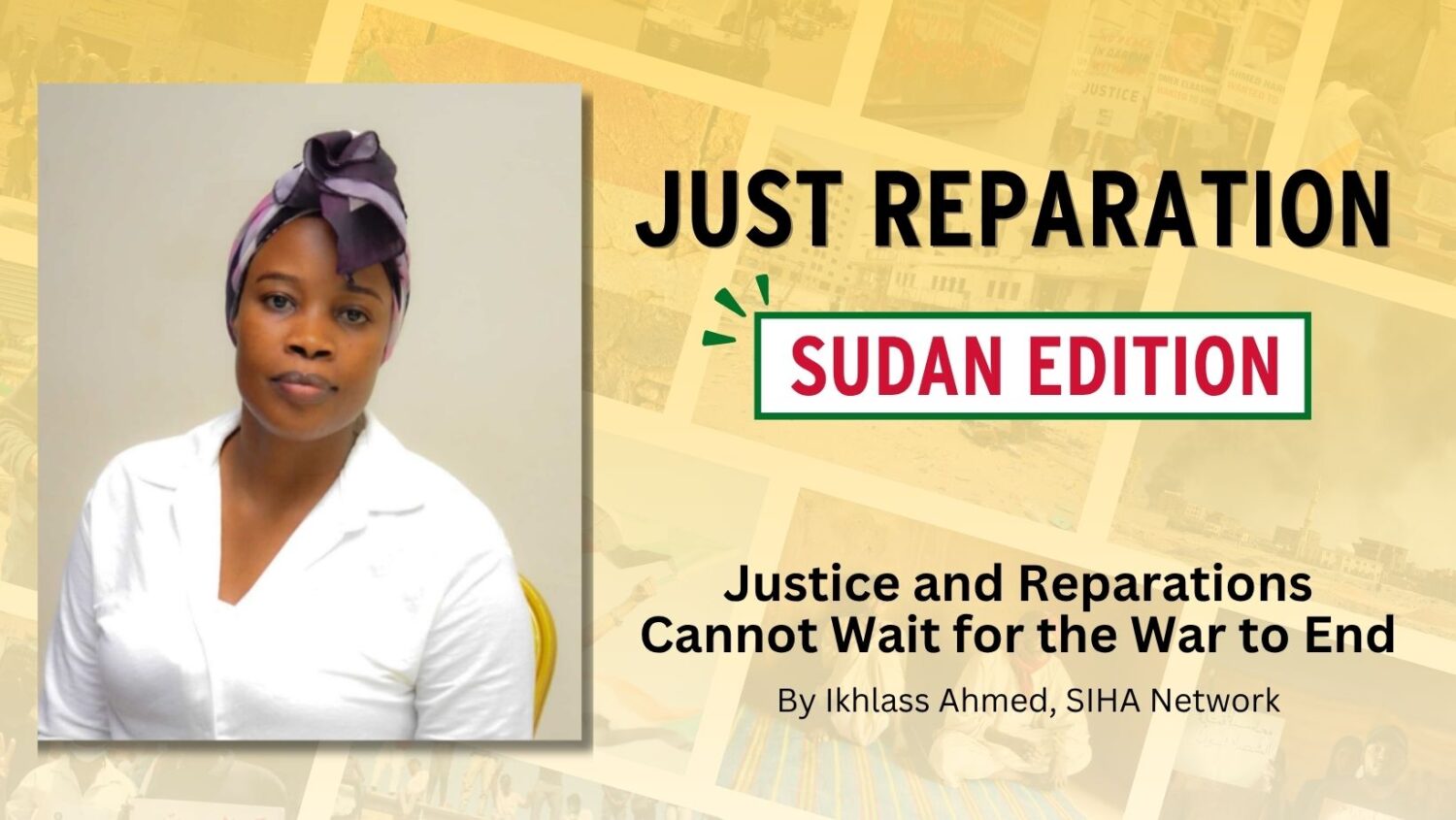
Justice and Reparation Cannot Wait for the War to End
By Ikhlass Ahmed, SIHA Network
Lire en français Leer en español Читати українською
This article is part of the Sudan edition of our Just Reparation newsletter, which brings together perspectives from practitioners, advocates, and organisations working alongside survivors of torture and other serious human rights violations in Sudan. This special edition explores ongoing discussions, initiatives, and pathways towards securing reparation for victims of the conflict in Sudan.
I was born and raised in Al-Fasher, where my memories, my family, and much of my identity originate. During this war, I have lost people I love and the life I knew, and I have watched the city I call home endure unimaginable violence. So, when I speak about justice and reparation in Sudan, I am not speaking only as someone who works with survivors. I am also speaking as someone who knows what loss feels like, what it means to keep waiting, and how painful it is to wonder whether justice will ever come.
And my experience is not separate from what many women in Darfur have lived through.
Some women who survived sexual violence during the conflict in Sudan that began in 2003 rebuilt their lives in displacement camps, only to be forced to flee again after April 2023. Some have faced new violence and loss. Their lives cannot be divided neatly into “the Darfur conflict” and “the current war”. The harm accumulates.
That is why survivors should not have to wait for peace before reparation begins.
Reparation is often understood as money. Although compensation is important, it is not the only form needed. The losses far exceed the scope of smaller competitions or startup funds. When we sit with survivors, we hear that repair also begins with recognition. For example, for a woman who has carried the stigma of rape for years, hearing that what happened was a crime and that responsibility lies with the perpetrator is important.
The difficult question is how to do this while Sudan is still at war:
Reparation should move on two tracks at once. The first is urgent interim support that reaches survivors now: healthcare, psychosocial care, livelihood support, legal assistance, replacement documents, and safe support for children born of rape. The second is a longer-term reparation programme that is survivor-led, gender-responsive, and connected to accountability. The first track can begin even while institutions are fractured; the second must be built so that emergency support becomes part of a credible reparation framework, not a substitute for justice.
Institutions are fractured, and survivors are displaced across borders. But these realities should change how reparations are delivered, not become an excuse to postpone them. We can start with a comprehensive national programme that acknowledges the endurance that may not be possible today.
International actions: Justice and Reparation Must Arrive in Time
Darfur shows us why timing matters. On 9 December 2025, the International Criminal Court (ICC) convicted Ali Muhammad Ali Abd-Al-Rahman (Ali Kushayb), on war crimes and crimes against humanity committed in Darfur in 2003 and 2004, including rape. For survivors who had waited more than two decades, this recognition mattered. Reparations proceedings in the case are now underway.
But the conviction came while many Darfuri communities are again facing grave violence. The United Nations (UN) Fact-Finding Mission (FFM) on Sudan has reported that the Rapid Support Forces (RSF) and allied militias target non-Arab communities in and around El Fasher, including Zaghawa, Fur, Masalit and Tunjur civilians, and documented killings, rape, sexual slavery, forced displacement and persecution.
For communities that lived through the atrocities of 2003, this repetition has deeply damaged trust in international justice. People ask a painful question: if justice takes more than twenty years, but the same communities can be attacked again by forces that grew out of structures responsible for earlier atrocities, what did that justice protect them from?
For many survivors, these events are happening in full view of the world. Justice moves slowly, while members of the same communities continue to face killings, displacement, and sexual violence. This is why some victims and communities are losing trust in international justice mechanisms. They are asking what accountability means if it recognises yesterday’s crimes but cannot help preventing their repetition.
What is needed?
Reparation must address this crisis of trust to be effective. Recognition must be accompanied by accountability, protection, and serious efforts to prevent repetition. Otherwise, the promise of “guarantees of non-repetition” becomes difficult for survivors to believe.
When we listen to survivors, their understanding of repair is often practical. One woman displaced to Chad told us, “I need psychological support. I am far from my children.” Another asked for spaces where survivors could meet, support one another, and develop livelihood projects. These requests tell us what justice looks like in daily life: treatment, education, income, safety, community, and the possibility of rebuilding.
This is precisely why women’s organisations and survivor networks must be at the centre of the design and implementation of reparations. Their experiences and expertise are indispensable in determining which harms are recognised, what forms of reparation are meaningful, how women can safely access reparations processes, and how programmes are monitored and evaluated. Survivors are not merely witnesses for courts or sources of information for reports. They are rights-holders whose voices, priorities, and agency must shape every stage of the reparative process.
For survivors, reparations can begin with something simple but profound: We believe you. What happened to you matters. And we will not accept that it happens to you again.
Read other articles in this series:
- The Potential Role of an International Accountability Mechanism for Sudan
- From Internal Displacement to Reparation: Why Compensation for War Victims in Sudan Must Start Now
- From Documentation to Reparation: Why Sudan Needs a Victims’ Registry
- Accountability, Victims’ Rights and Reparation in Sudan: A Country in Crisis
- Born as a Result: An Open Question for the Reparation Phase
- Galvanising the African Union’s Role on Sudan
This edition of the Just Reparation newsletter was co-funded by the European Union. Its contents are the sole responsibility of the organisations that produced this publication and do not necessarily reflect the views of the European Union.
