
Global Initiative Against Impunity for International Crimes and Serious Human Rights Violations
Working with partners and survivors to confront the global rise in impunity
Learn more about the Global Initiative
In recent decades, significant efforts have been made to confront impunity for violations of human rights, humanitarian law, and international criminal law. Despite this progress, major challenges remain to deliver justice to survivors. Impunity has been fuelled by the erosion of national and international accountability mechanisms, the targeting or criminalisation of justice actors and human rights defenders, the lack of meaningful participation by survivors, weak political will, and inadequate legal frameworks. These challenges have been compounded in recent years by shrinking civic space for victims and human rights defenders, as well as the increasing risks they face.
To respond to this rising climate of impunity, REDRESS has joined forces with eight other civil society organisations and two associate partners to lead the “Global Initiative Against Impunity for International Crimes and Serious Human Rights Violations: Making Justice Work” (GIAI). The consortium members are Civil Rights Defenders, the Coalition for the International Criminal Court, the European Center for Constitutional and Human Rights, Impunity Watch, the International Federation for Human Rights, Parliamentarians for Global Action, REDRESS, TRIAL International, and Women’s Initiatives for Gender Justice. The initiative is supported by two associate partners: the Auschwitz Institute for the Prevention of Genocide and Mass Atrocities and the International Commission of Jurists.
Working in collaboration with their national and regional partners, the organisations contribute their expertise in promoting victim-centred, trauma informed, and gender sensitive approaches to justice and accountability for serious human rights violations, including torture and enforced disappearance, as well as core international crimes such as genocide, crimes against humanity, war crimes, and the crime of aggression.
The four-year Initiative, which was launched 2023, is co-funded by the European Union. It focuses on nearly 30 countries across Africa, the Americas, Asia, Europe, and the Middle East, while also advancing the rule of law, accountability, and atrocity prevention across other countries in these regions.
The GIAI has developed a comprehensive approach to securing meaningful justice and accountability for survivors and victims by working on two main fronts:
- Enhancing the agency and participation of victims and civil society in shaping inclusive justice and accountability processes, recognising that their exclusion undermines meaningful justice and sustainable change.
- Strengthening accountability frameworks and systems to challenge impunity through dialogue, advocacy, and awareness-raising among justice providers, duty-bearers, survivors, and civil society organisations.
All actions are guided by a survivor-centred approach and promote trauma-informed and gender-responsive practices, enabling victims to participate as active agents and advocates for justice. This approach is rooted in a broad understanding of impunity, its root causes, and the systemic drivers that allow it to persist.
The threat of impunity is too great to tackle alone, but through collaboration, the GIAI helps make justice work for those who need it most.
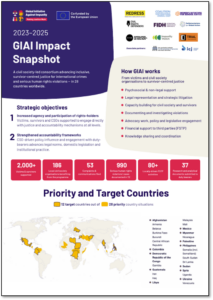
Learn more about our impact in 2023-2025:
Hear what ‘Making Justice Work’ means to our partners:
If you would like to get involved or learn more about this initiative, please contact us on [email protected].
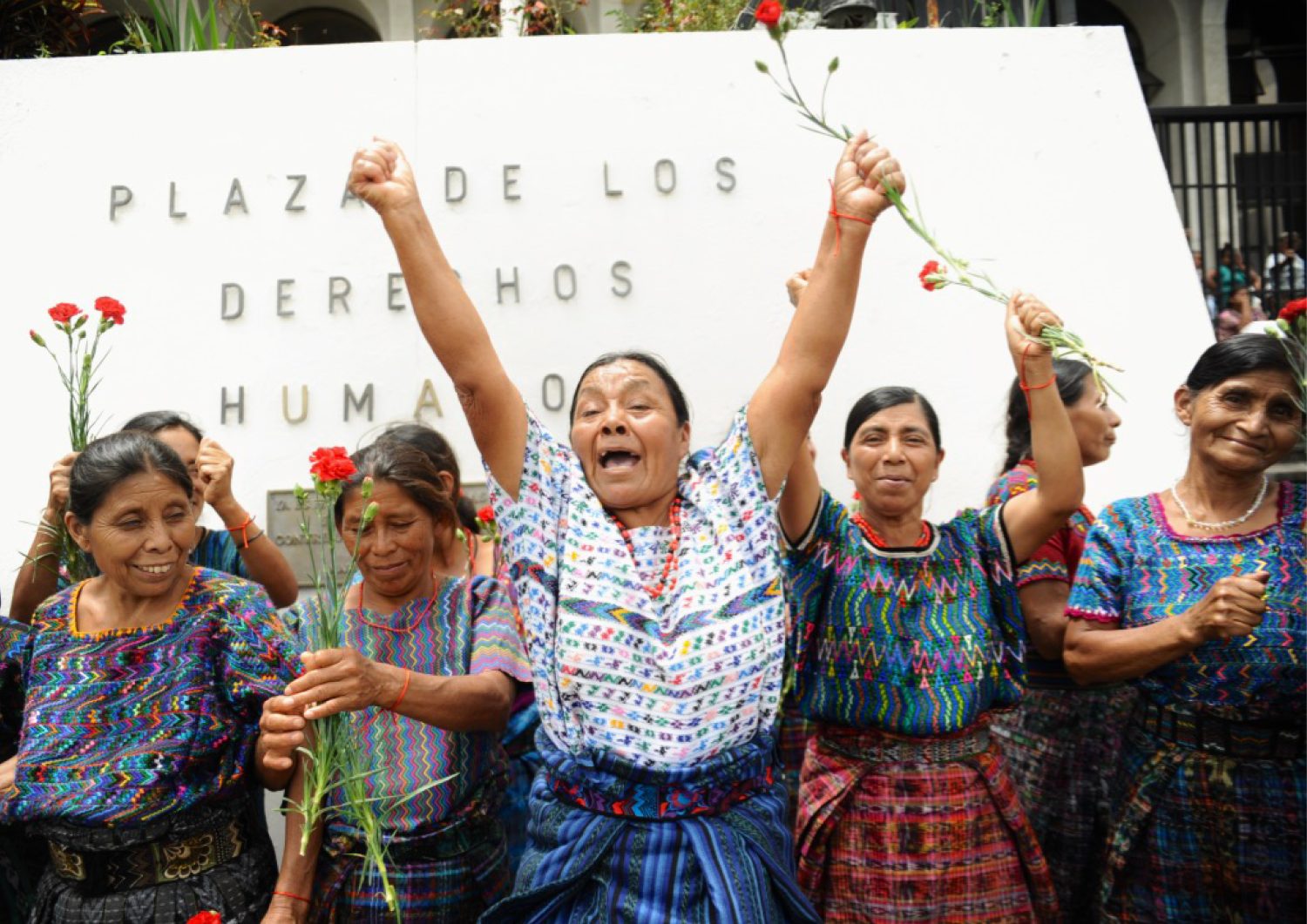
Photo: Cristina Chiquin/Impunity Watch. Maya Achi women participate in the commemoration of the National Day Against Forced Disappearances in Guatemala City on 21 June 2019. In January 2022, they won a case against five former paramilitaries who subjected them to acts of sexual violence and slavery during the internal armed conflict.