Publications
REDRESS’ publications are also available in hard copy format. Please contact us for further information on [email protected].
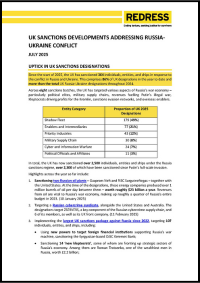
As of July 2025, the UK has sanctioned 364 individuals, entities, and ships in response to the Russia–Ukraine conflict — accounting for 86% of all UK designations this year and already surpassing the total number imposed in 2024. This briefing outlines the key highlights in the UK’s sanctions policy on Russia and Ukraine and analyses significant developments. It also includes an Annex listing all sanctions designations addressing the conflict made in 2025, as of July.
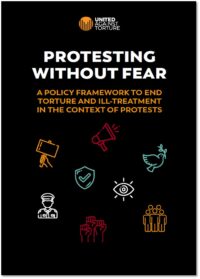
This policy paper addresses this critical issue and aims to provide a series of legally grounded and practically oriented recommendations to State actors based on the application of the international anti-torture framework, a powerful yet underutilised tool for prevention, protection and redress. It also draws on other relevant human rights instruments notably the Model Protocol for Law Enforcement Officials to Promote and Protect Human Rights in the Context of Peaceful Protests (2024) (hereinafter “the Model Protocol”), as a key tool that provides States with practical guidance on ensuring human rights compliance in the facilitation of protests.
The policy paper outlines essential measures that States should adopt, supported by concrete, country-specific examples of good practice. It has been drafted under the guidance of the United Against Torture Consortium (UATC) Working Group on Torture and Other Ill-Treatment in the Context of Protests and Other Assemblies, composed of a global and multidisciplinary group of representatives from international expert bodies and civil society organisations.
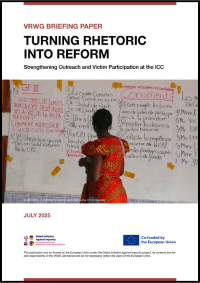
After reconvening in 2024, the Victims’ Rights Working Group (VRWG) prioritised engagement with the ICC’s revision of its outdated Victims Strategy. This position paper from the VRWG Secretariat highlights key gaps in the Court’s current approach—including limited early outreach, increasingly restrictive jurisprudence, and inequitable legal aid—and offers concrete recommendations to centre victims’ rights. Published ahead of the ICC Victims Strategy Seminar in July 2025, the paper urges the Court and States Parties to ensure meaningful victim participation in the revised strategy and beyond.
State hostage-taking, where individuals are arbitrarily detained by foreign governments for diplomatic leverage, involves serious violations of human rights, including the right not to be subjected to torture and ill-treatment. It is widely accepted that the practice of State hostage-taking is increasing internationally. British nationals are among the most frequent targets of hostage-taking globally, and face some of the worse outcomes. This briefing outlines why the UK government should introduce a Special Envoy for Complex and Arbitrary Detentions with sufficient authority, resource, and mandate to lead diplomatic responses, while treating families as trusted partners.
Torture and ill-treatment in India are widespread and systemic, often carried out with impunity by State authorities. This report calls for urgent legal and policy reforms by the Indian Government and the international community to prevent torture, ensure justice for survivors, and eliminate these grave abuses.
This report was prepared by REDRESS in consultation with legal practitioners and civil society members with expertise on torture-related issues in India. REDRESS conducted data collection and analysis using desk-based and open-source research, drawing on publications, statements, and reports from national bodies, UN bodies, national and international NGOs, and media outlets. This publication was funded by the European Union and produced under the United Against Torture Consortium initiative (UATC). Its contents are the sole responsibility of REDRESS and do not necessarily reflect the views of the European Union.
Written evidence by REDRESS to the UK Parliament's Joint Committee on Human Rights on amending the International Criminal Court Act 2001 and the Criminal Justice Act 1988 through the Crime and Policing Bill to strengthen universal jurisdiction in the UK. The submission also covers how the Crime and Policing Bill presents a critical opportunity to strengthen the UK's ability to provide reparation for survivors of serious human rights violations by reforming the Proceeds of Crime Act 2002.
In this letter, REDRESS and 32 NGOs called on the Prime Minister to make clear to President al-Sisi that what happens to Alaa and his mother will have ramifications “both for Egypt’s reputation and standing on the international stage, and for the future of its relationship with Britain, including cooperation on tourism, trade, and investment.”
REDRESS' submission in response the the UK Foreign Affairs Committee's call for evidence, addressing how UK Parliament can most effectively conduct scrutiny of the FCDO's sanctions regimes, at what stage parliament should be consulted, and which aspects of sanctions policy would benefit most from broad and open discussion.