Publications
REDRESS’ publications are also available in hard copy format. Please contact us for further information on [email protected].
A survivor-centred framework designed to strengthen accountability, justice, and rehabilitation globally. It outlines key rights, including the right to dignity, safety, truth, reparation, and access to medical/psychosocial care, demanding that states reform systems to support recovery and hold perpetrators accountable.
This briefing contains the key recommendations from REDRESS’s June 2025 report Torture Normalised: State Violence in India, accompanied by commentary on instances where these same recommendations have been raised in international fora, yet have failed to elicit meaningful action from the Indian government.
This guidance document explores how civil society can play a stronger role in helping authorities locate and apprehend suspects of serious international crimes. It outlines the institutional framework, the role and methods of CSOs, the challenges they face, and practical measures to strengthen their capacity to provide timely, reliable information on suspects’ movements. The document offers recommendations for States, international bodies, CSOs, and donors to improve coordination and increase the likelihood of arrests when suspects cross into new jurisdictions.
This briefing paper is designed to highlight the reparation framework in Bangladesh and its limitations in providing comprehensive reparation to victims of torture and ill treatment, measured against international standards. In light of this analysis, we provide recommendations for key stakeholders to improve access to justice and to ensure the right of survivors to reparation. The briefing paper has been prepared jointly by Bangladesh Legal Aid and Services (BLAST) and REDRESS as part of a wider project partnership seeking to address key issues in relation to accountability, justice, and reparation for torture in Bangladesh.
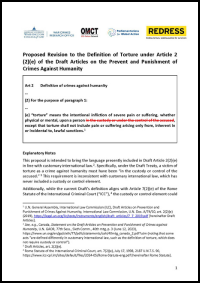
This briefing calls for revising the definition of torture under Article 2 (2)(e) of the Draft Articles on the Prevent and Punishment of Crimes Against Humanity Convention. The briefing was prepared by REDRESS, the World Organisation against Torture (OMCT), Parliamentarians for Global Action and the Washington College of Law's War Crimes Research Office.
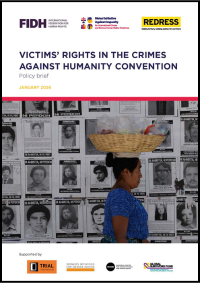
This briefing, prepared by REDRESS and the International Federation for Human Rights (FIDH) as part of the Global Initiative Against Impunity: Making Justice Work (GIAI), sets out concrete recommendations to ensure that the future Convention on the Prevention and Punishment of Crimes against Humanity is firmly grounded in victims’ rights and survivor-centred justice. This publication was funded by the European Union. Its contents are the sole responsibility of the organisations that produced it and do not necessarily reflect the views of the European Union.
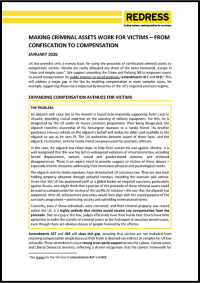
UK law provides only a narrow basis for using the proceeds of confiscated criminal assets to compensate victims. Victims are rarely allocated any share of the sums recovered, except in “clear and simple cases”. This briefing outlines REDRESS' support for amending the Crime and Policing Bill to empower courts to award compensation for public interest or social purposes (amendments 417 and 419).
Спільна заява українських груп постраждалих щодо створення Міжнародної комісії з розгляду вимог щодо України, у якій держави закликаються підписати та ратифікувати Конвенцію, водночас наголошуючи на необхідності інклюзивного, орієнтованого на постраждалих підходу до репарацій, включно з жертвами, які зазнали шкоди до повномасштабного вторгнення.