Publications
REDRESS’ publications are also available in hard copy format. Please contact us for further information on [email protected].
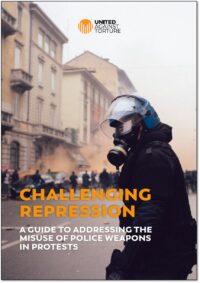
This document is designed to provide practical guidance for these stakeholders to assist them in identifying, documenting, and challenging such misuse in a protest context. It complements several existing resources, including the United Against Torture Consortium (UATC) Policy Paper – Protesting without Fear (2025), the OSCE Guide on Law Enforcement Equipment Most Commonly Used in the Policing of Assemblies (2021), and Lethal in Disguise 2 (INCLO and Physicians for Human Rights, 2023), and brings a specialist focus on equipment used in protest contexts.
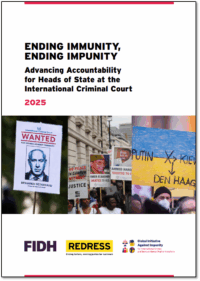
The Rome Statute affirms that even the most powerful individuals can be held to account when national systems fail. For millions denied justice at home, the International Criminal Court offers a vital source of hope. That hope diminishes each time a State Party declines to arrest a sitting head of state wanted by the Court on grounds of personal immunity. Such failures erode the collective commitment underpinning the Rome Statute and risk turning a clear legal framework into a political choice. This paper explains why personal immunities cannot bar cooperation with the International Criminal Court and why reaffirming this principle is essential to preserving equality before the law and ensuring the Court remains a credible avenue for accountability.
This submission offers evidence in response to the House of Lords Select Committee on International Agreements’ call for evidence in relation to their inquiry investigating the impacts and implications of the UK-India Free Trade Agreement for the UK. This submission addresses the question: What are the human rights implications of entering into a free trade agreement with India? How are these risks acknowledged and mitigated within the agreement, particularly in relation to supply chains and business operations?
Survivors of serious human rights and international humanitarian law violations have a legal right to reparation, but in practice this is often inaccessible, leaving them without redress. This briefing examines how illicit assets linked to Syria’s civil war could be recovered and redirected to fund reparation for survivors. With a new Directive on Asset Recovery and Confiscation, a large share of frozen Syrian assets, and a stated commitment to supporting transitional justice as part of state and peace building, the EU and its Member States are well placed to act. The briefing sets out concrete recommendations to facilitate asset recovery for reparation in the Syrian context, informed by consultations with Syrian survivors and civil society.
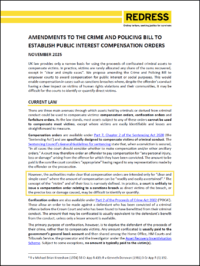
UK law provides only a narrow basis for using the proceeds of confiscated criminal assets to compensate victims. In practice, victims are rarely allocated any share of the sums recovered, except in “clear and simple cases”. In this briefing, we propose amending the Crime and Policing Bill to empower courts to award compensation for public interest or social purposes, enabling compensation in cases such as sanctions breaches where, despite the offender’s conduct having a clear impact on victims of human rights violations and their communities, it may be difficult for the courts to identify or quantify direct victims.
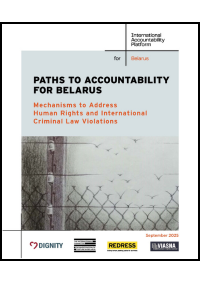
This report, published by the International Accountability Platform for Belarus (IAPB) provides an in-depth mapping of accountability mechanisms capable of addressing serious human rights violations and breaches of international criminal law in Belarus. It distinguishes between mechanisms that address state responsibility, those focused on individual criminal liability, and hybrid approaches that serve both functions.
At present, the UK’s ability to prosecute grave international crimes under universal jurisdiction is limited. The Joint Committee on Human Rights (JCHR) has criticised the current legal framework for creating “barriers to accountability”. This briefing supports the proposed recommendation from the JCHR and the International Development Committee and outlines the practical consequences if the law is not reformed. Adopting these amendments would close a loophole, empower prosecutors to more effectively exercise universal jurisdiction, and help ensure the UK does not become a safe haven for those accused of international crimes.
An open letter from REDRESS and the Kurdistan Human Rights Network, signed by 22 human rights organisations and 13 individuals, calls on Iran to provide urgent medical treatment to Zeinab Jalalian, the country's longest-held female political prisoner. Zeinab Jalalian, a Kurdish women’s rights activist, was handed a death sentence in 2008, later commuted to life imprisonment, after a deeply flawed trial. She is currently held in Yazd Central Prison, where at least eight prisoners — including one woman — were reportedly executed in the past two months. Despite suffering from several potentially life-threatening illnesses, Iranian authorities have consistently denied Zeinab access to the medical care she urgently needs for proper diagnosis and treatment.